


RCC Secretary General Amer Kaptanovic Takes Part at Budapest Balkans Forum 2026
10 March 2026
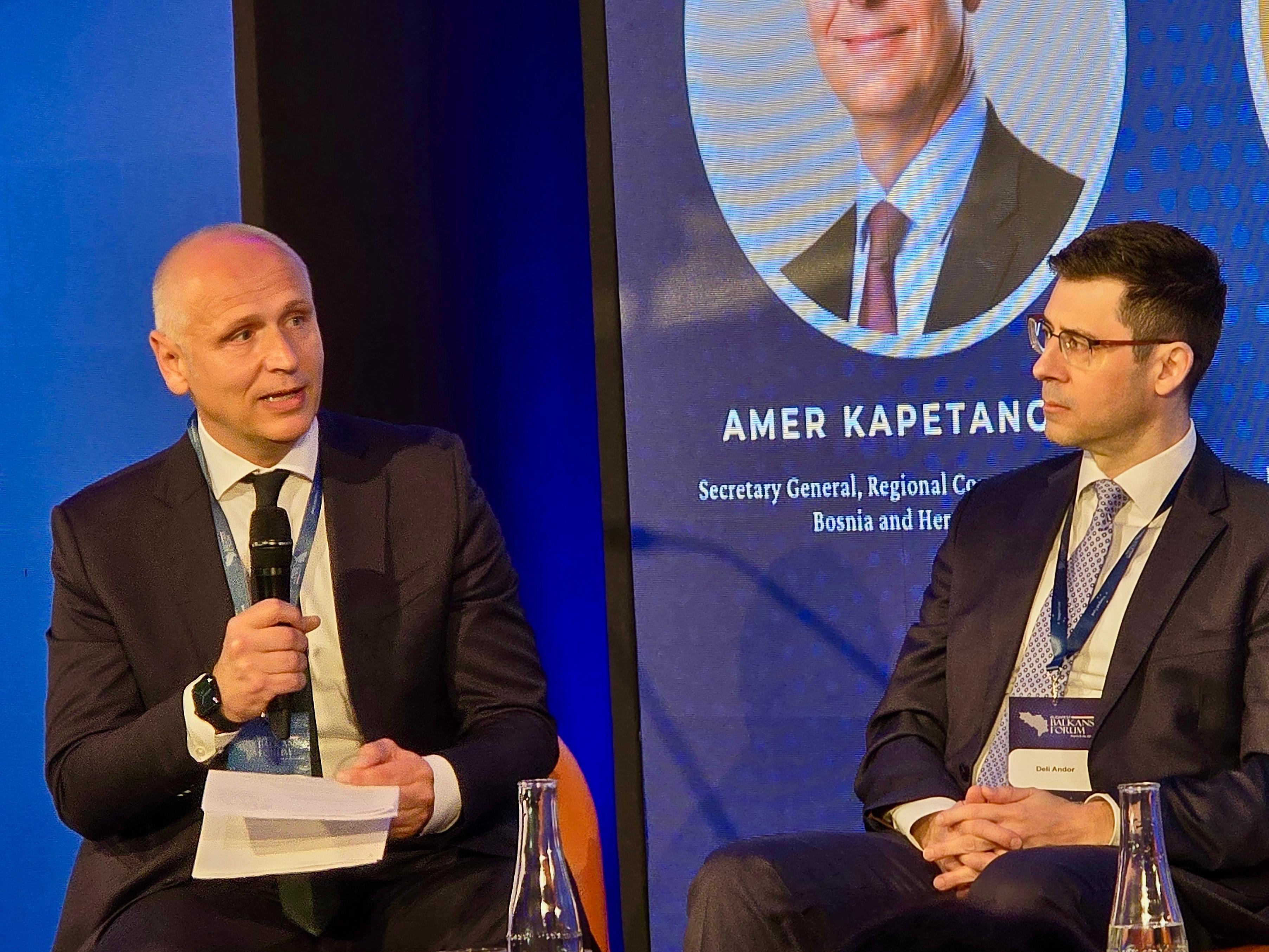
RCC Secretary General Amer Kapetanovic speaking at the Budapest Balkan Forum 2026 (Photo: RCC/Edin Sabljica)

Secretary General of the Regional Cooperation Council (RCC), Amer Kapetanović, participated in the Budapest Balkans Forum 2026 on 10 March 2026 (Photo: RCC/Edin Sabljica)
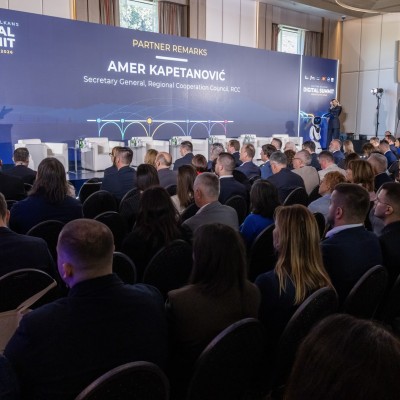
Budapest, 10 March 2026 – Secretary General of the Regional Cooperation Council (RCC), Amer Kapetanović, participated today in the Budapest Balkans Forum 2026, where he joined a high-level panel discussion on strengthening regional stability through strategic connectivity, and held a series of bilateral meetings with senior Hungarian officials and policy leaders.
Kapetanović took part in the panel discussion titled “Building a Stable and Secure Region through Strategic Connectivity,” which gathered senior officials and experts to discuss the role of infrastructure, energy cooperation and broader policy alignment in strengthening regional resilience and advancing European integration in South East Europe.
"The central question for the Western Balkans is not simply how to connect more, but how to remain competitive within deeper integration with the European and global economy. Connectivity without security creates vulnerability, and connectivity without investment is just geography. With the right investments, coordination, and regional cooperation, it becomes economic transformation," said Kapetanović.
Alongside the RCC Secretary General, the panel featured Andor Deli, Ministerial Commissioner responsible for facilitating the implementation of European connectivity at the Ministry of European Union Affairs of Hungary; and Ana Trišić-Babić, former acting president of Republika Srpska, Bosnia and Herzegovina. The discussion was moderated by Miša Đurković, Head of the MCC-MKI Center for Geopolitics at the Mathias Corvinus Collegium–Hungarian Institute of International Affairs.
During the discussion, Kapetanović highlighted the importance of connectivity, not only in terms of infrastructure, but also through economic cooperation and policy coordination, as a key driver of prosperity across South East Europe. He also stressed that regional agendas and cooperation frameworks already in place provide a strong foundation for advancing connectivity across the region.
Hungary is an RCC Board Participant, hence during a visit to Budapest, Kapetanović held bilateral meetings with Péter Sztáray, State Secretary for Security Policy and Energy Security at the Ministry of Foreign Affairs and Trade of Hungary; Gladden Pappin, President of the Hungarian Institute of International Affairs; and László Kövér, Speaker of the National Assembly of Hungary. Discussions focused on regional priorities, connectivity and the broader EU integration agenda for South East Europe, as well as the role of policy dialogue and parliamentary engagement in advancing regional cooperation.
******
The Regional Cooperation Council (RCC) is a regionally owned and led political cooperation framework, established in 2008 as the successor to the Stability Pact for South Eastern Europe. Serving as the operational secretariat of the South-East European Cooperation Process (SEECP), the RCC provides the institutional structure and political space necessary to sustain dialogue across South East Europe. Its Board brings together 25 participants, including 14 EU Member States and 5 G20 members, reflecting its broad international relevance. Headquartered in Sarajevo, with a Liaison Office in Brussels, the RCC acts as a bridge between regional priorities and European and global decision-making.