

Youth voices at the centre of France’s Minister Delegate for Europe Benjamin Haddad’s visit to RCC
02 June 2026
The Regional Cooperation Council (RCC) hosted French Minister Delegate for Europe Benjamin Haddad for a visit to the RCC Secretariat in Sarajevo (Photo: RCC/Jasmin Sakovic)

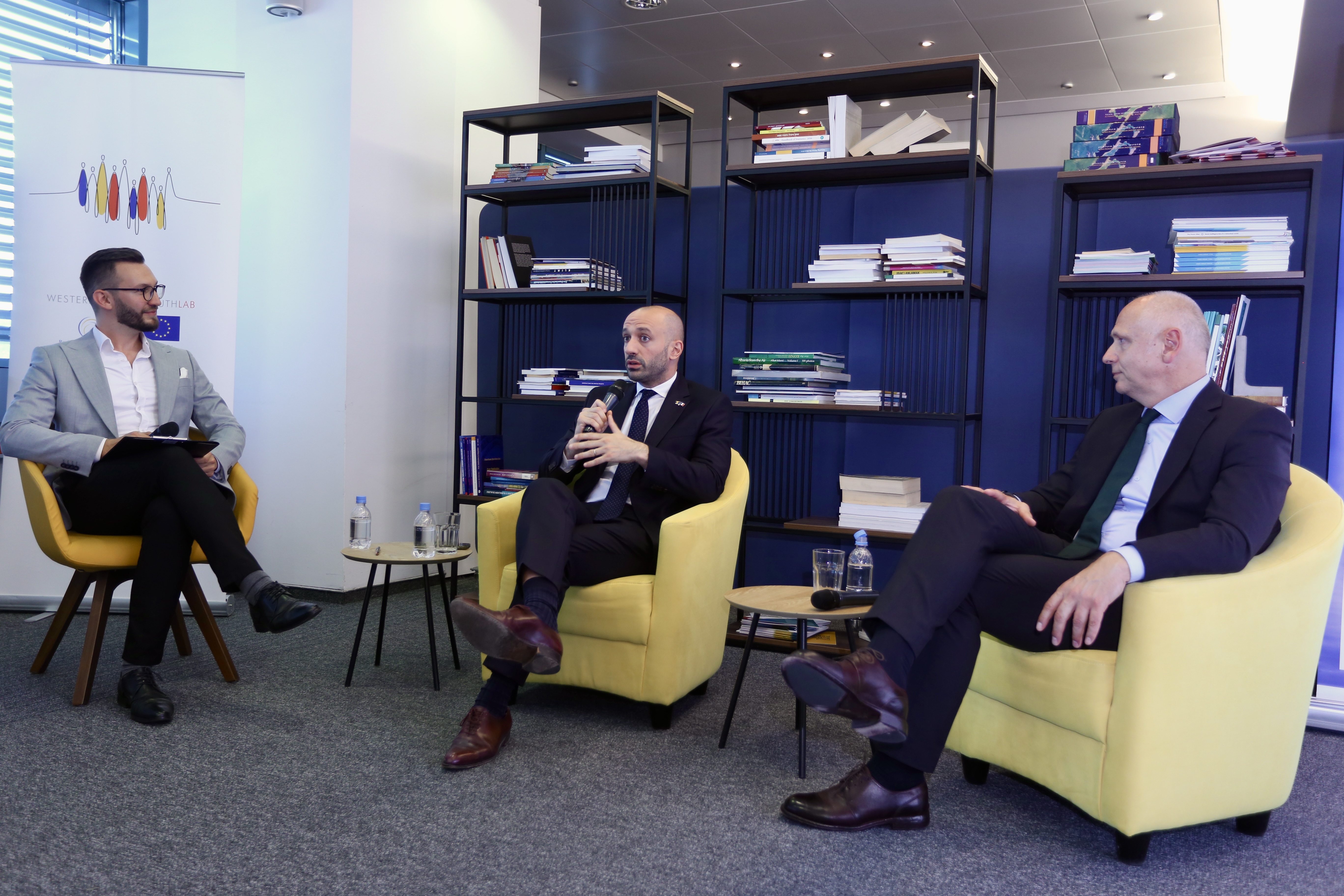
RCC hosted French Minister Delegate for Europe Benjamin Haddad for a visit to the RCC Secretariat in Sarajevo and organized Fireside Talk with young people from the Western Balkans, organised within EU-funded and RCC-implemented Western Balkans Youth Lab 2 (WBYL) project in RCC Headquarters in Sarajevo on 2 June 2026 (Photo: RCC/Jasmin Sakovic)
Sarajevo, 2 June 2026 – The Regional Cooperation Council (RCC) hosted today French Minister Delegate for Europe Benjamin Haddad for a visit to the RCC Secretariat in Sarajevo, combining a bilateral meeting with RCC Secretary General Amer Kapetanović and a dynamic Fireside Talk with young people from the Western Balkans, organised within EU-funded and RCC-implemented Western Balkans Youth Lab 2 (WBYL) project.
The Fireside Talk brought together Minister Delegate Haddad and RCC Secretary General Kapetanović in an open exchange with young people from the region on Europe, regional cooperation, youth participation, and the future of the Western Balkans.
“Regional cooperation is not an abstract diplomatic exercise. It is a daily practice of listening, connecting and delivering. And nowhere is this more visible than when young people are in the room, not as an audience, but as equal voices. The Western Balkans does not need young people to only believe in its European future, it needs them to help shape it,” said RCC Secretary General Amer Kapetanović.
“EU accession is not a cosmetic change; it is a profound transformation. I deeply appreciate the hard work of the Western Balkans on this path, and it was important for me to hear directly from young people what they expect from the European Union and where we need to step up. Their energy, innovation, and perspective can bring a much-needed rejuvenation to the European project. The EU also has a responsibility to offer concrete benefits so that people can see and feel the results of the reforms they are undertaking,” said Minister Delegate Benjamin Haddad.
The discussion gave young participants, including Young European Ambassadors, representatives of the Youth Council of the Federation of Bosnia and Herzegovina, and students from the University of Sarajevo’s Faculty of Political Sciences, space to speak directly about what they would want Europe to better understand about the Western Balkans. Their messages were clear: the region is more than its political headlines; it is creative, resilient, talented and ready to contribute. They spoke about the need to move beyond stereotypes, to recognise young people as partners in policymaking, and to see the Balkans not only as a region waiting to join Europe, but as a region already shaping Europe through its people, ideas, culture and cooperation.
As a symbolic gesture, RCC presented Minister Delegate Haddad with a coffee cup and coffee, accompanied by the message that in the Balkans, every important conversation begins with coffee. Young participants also wrote personal messages on postcards featuring motives from the region, answering one simple question: If you could tell the EU one thing about the Balkans, what would it be? Their answers will remain as a reminder that the region’s European story is also personal, human and deeply generational.
The Fireside Talk was organised within the Western Balkans Youth Lab, which works to strengthen youth participation in policymaking and create structured dialogue between young people and decision-makers across the region.
Following the Fireside Talk, Minister Delegate Haddad and Secretary General Kapetanović held a bilateral meeting, discussing regional cooperation, EU enlargement momentum, the future of the Berlin Process, and France’s continued engagement in the region, including through its role as a participant in the RCC Board. The meeting also served as an opportunity to exchange views ahead of continued RCC engagement with French institutions and partners.
France is an important partner of the RCC and a participant in the RCC Board, supporting regional cooperation as a tool for stability, connectivity and a stronger European future of South East Europe.
***
The Regional Cooperation Council (RCC) is a regionally owned and led political cooperation framework, established in 2008 as the successor to the Stability Pact for South Eastern Europe. Serving as the operational secretariat of the South-East European Cooperation Process (SEECP), the RCC provides the institutional structure and political space necessary to sustain dialogue across South East Europe. Its Board brings together 25 participants, including 14 EU Member States and 5 G20 members, reflecting its broad international relevance. Headquartered in Sarajevo, with a Liaison Office in Brussels, the RCC acts as a bridge between regional priorities and European and global decision-making.
The Regional Cooperation Council (RCC)’s Western Balkans Youth Lab 2 (WBYL2) is an EU-funded project that promotes a sustained and structured regional dialogue between young people and policy-makers. Its purpose is to co-create policies that strengthen youth participation in public decision-making and contribute to a more enabling socio-economic environment for young people across the Western Balkans.