

Regional Cooperation Key to Credible EU Path, RCC SG Kapetanović Says at Adria Future Summit
22 April 2026
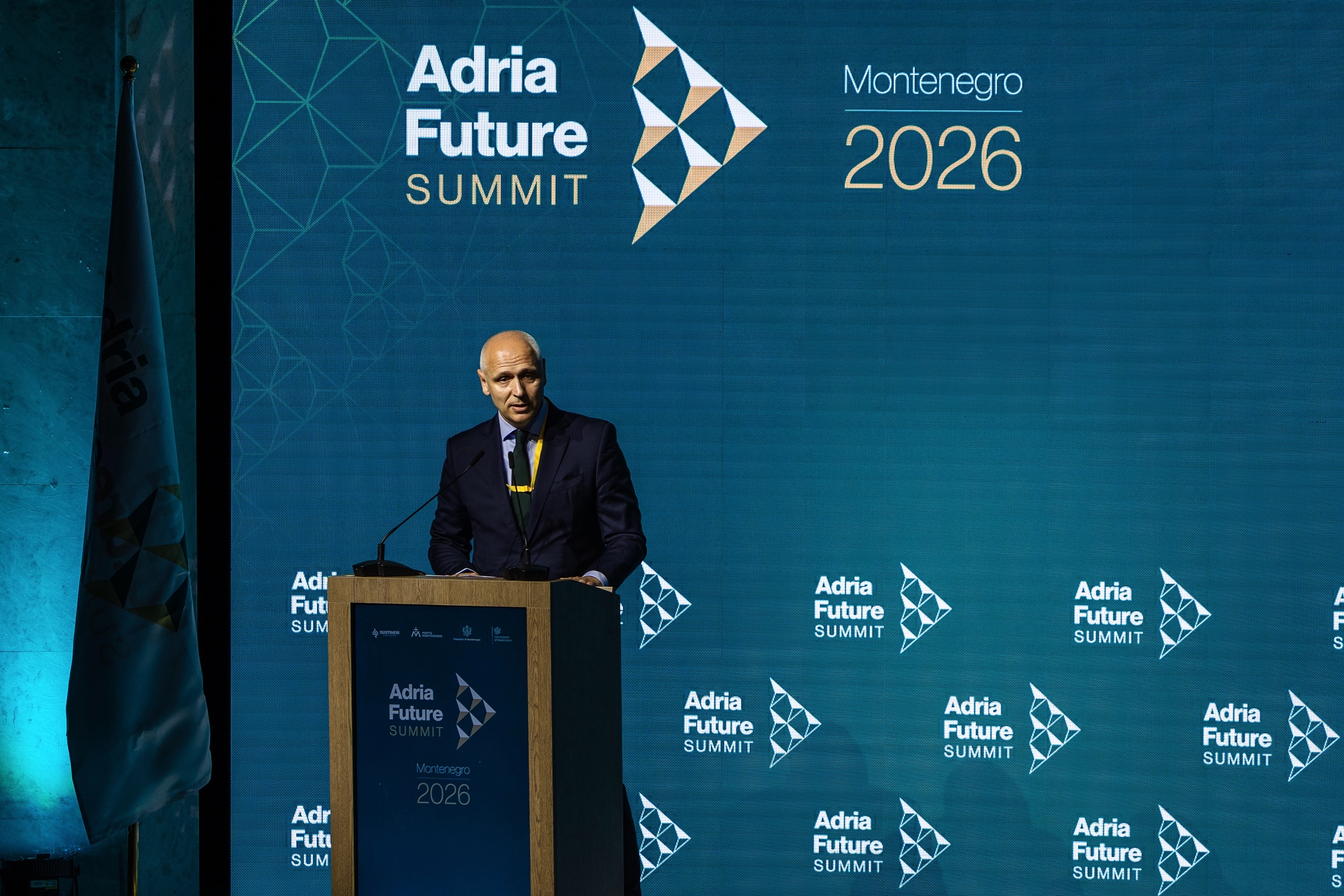
Secretary General of the Regional Cooperation Council (RCC), Amer Kapetanović, at the opening of the Adria Future Summit in Tivat on 22 April 2026 (Photo: Courtesy of Adria Future Summit)
Tivat, 22 April 2026 – Regional cooperation is not a political formality but a strategic necessity for credible European integration, said Secretary General of the Regional Cooperation Council (RCC), Amer Kapetanović, today at the opening of the Adria Future Summit in Tivat.
The Summit was officially opened with welcome remarks by Biljana Braithwaite, Founding Partner and CEO of Sustineri Partners, Predrag Leković, Director of Government Relations at Porto Montenegro, and Željko Komnenović, Mayor of Opština Tivat. Speaking at the keynote session “Regional Cooperation and the Road to EU Integration,” following the Summit opening Kapetanović stressed that in a time of growing geopolitical fragmentation and economic uncertainty, the Western Balkans must choose greater coherence over fragmentation.
“If EU membership is our main goal, and it is, then the road to Brussels leads through your neighbour’s yard. Regional cooperation is not a box to tick, it is a matter of strategic self-interest and a condition for credible accession,” Kapetanović said.
He underlined that the region’s competitiveness and attractiveness for investment will depend on its ability to deliver concrete results, from mobility and digital integration to green transition and market integration, rather than declarations alone.
“Capital will follow implementation, not rhetoric. The region is too strategically positioned to be ignored, but it must become more predictable, more interoperable, and more investable,” he added.
Kapetanović highlighted the role of RCC in translating political commitments into practical cooperation, particularly through the Common Regional Market and Berlin Process deliverables, aimed at reducing barriers and preparing the region for gradual integration into the EU Single Market.
The Adria Future Summit, to be held from 22 to 24 April in Tivat, brings together government leaders, businesses, investors, and international organisations to advance dialogue on sustainable development, innovation, and investment in Southeast Europe.
During the remainder of the Summit, RCC will continue to contribute to key discussions on the region’s future. Later today, Secretary General Kapetanović will participate in a fifth Regional Fireside Talk, organised by RCC’s EU-funded Western Balkans Youth Lab (WBYL) project, focusing on youth engagement and the role of young people in shaping regional cooperation.
Tomorrow, he will also open the Mid-Term Review Conference of the Youth Policy Lab on Disinformation and Media Literacy, highlighting the importance of structured youth participation and regional collaboration in building a more resilient and forward-looking South East Europe.
Speech by RCC Secretary General
More information on Adria Future Summit
More information on the fifth Regional Fireside Talk
More information Mid-Term Review Conference of the Youth Policy Lab on Disinformation and Media Literacy
***
The Regional Cooperation Council (RCC) is a regionally owned and led political cooperation framework, established in 2008 as the successor to the Stability Pact for South Eastern Europe. Serving as the operational secretariat of the South-East European Cooperation Process (SEECP), the RCC provides the institutional structure and political space necessary to sustain dialogue across South East Europe. Its Board brings together 25 participants, including 14 EU Member States and 5 G20 members, reflecting its broad international relevance. Headquartered in Sarajevo, with a Liaison Office in Brussels, the RCC acts as a bridge between regional priorities and European and global decision-making.