

Climate impacts do not stop at boundaries, neither can our response, says RCC Secretary General in Tirana
05 May 2026
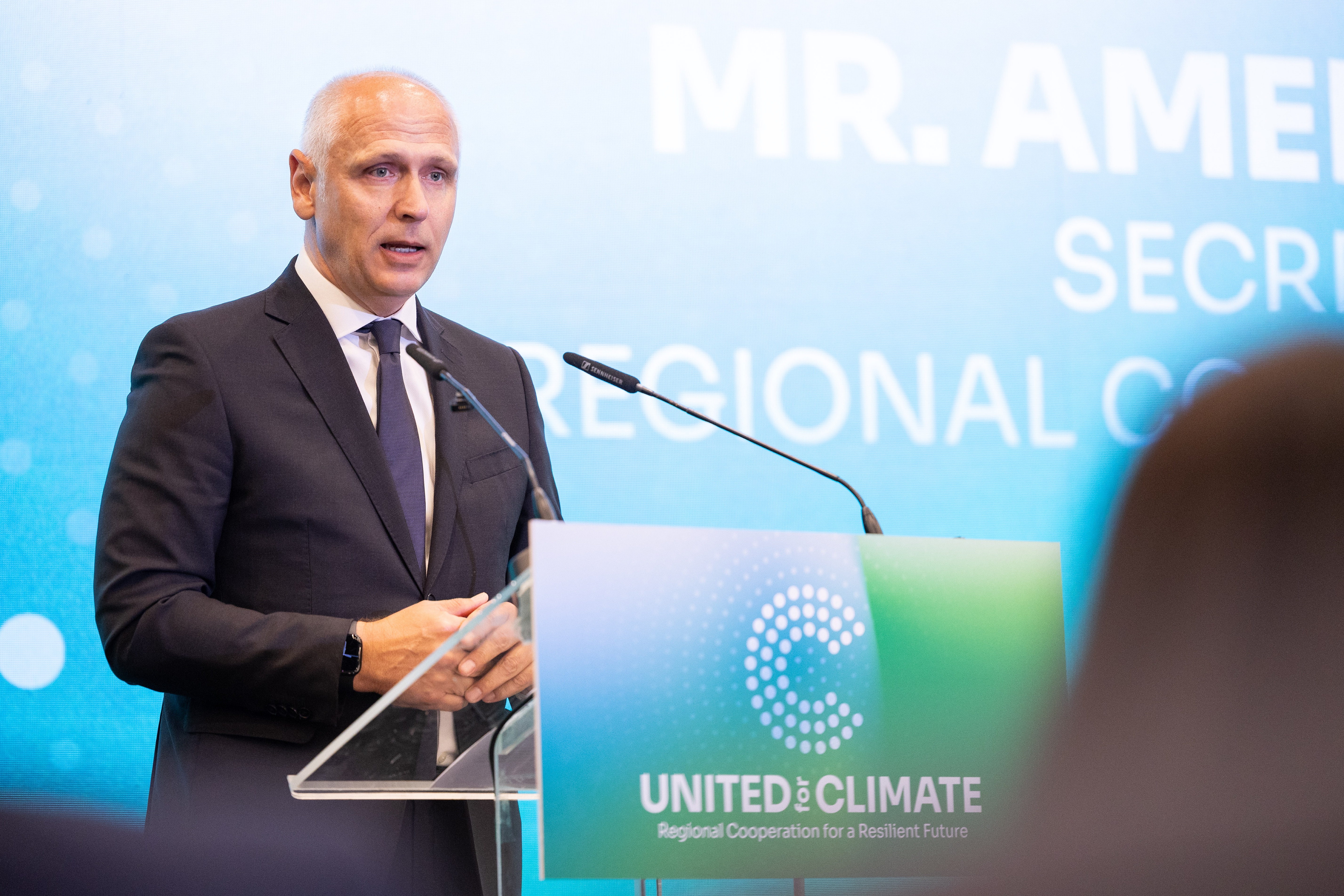
Secretary General of the Regional Cooperation Council (RCC) Amer Kapetanović opening the United for Climate: Regional Cooperation for a Resilient Future conference in Tirana on 5 May 2026 (Photo: RCC/Henri Koci)
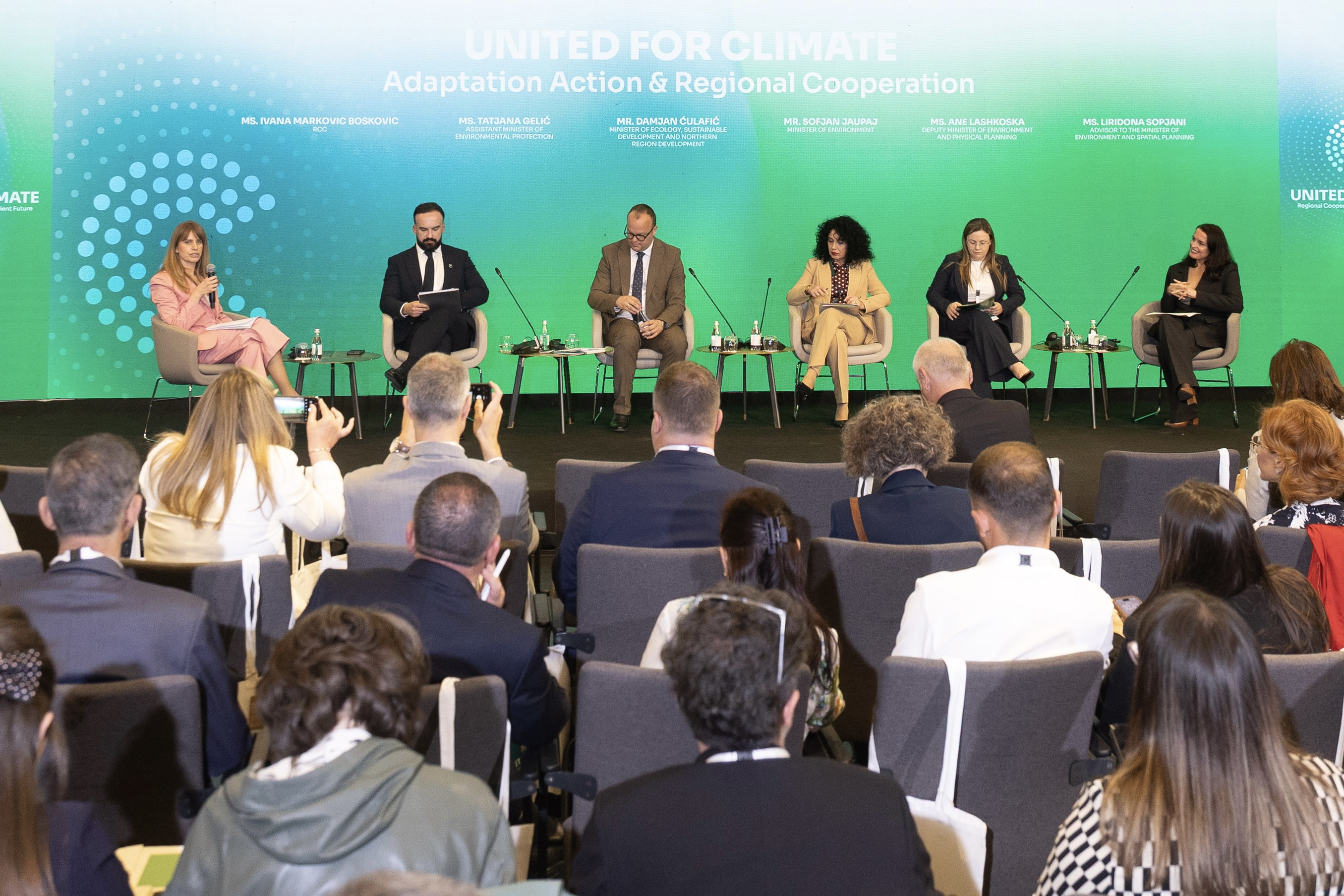
RCC’s Senior Expert on Green Agenda/Coordinator of the Green Agenda, Ivana Marković Bošković moderated the high-level ministerial panel “United for Climate – Adaptation Action & Regional Cooperation at the United for Climate: Regional Cooperation for a Resilient Future conference, in Tirana on 5 May 2026 (Photo: RCC/Henri Koci)
Tirana – Climate adaptation in the Western Balkans Six (WB6) must move from strategies to concrete, coordinated and bankable investments, said Secretary General of the Regional Cooperation Council (RCC) Amer Kapetanović today in Tirana, opening the United for Climate: Regional Cooperation for a Resilient Future conference.
The conference, organised by Ministry of Tourism and Environment of Albania and GIZ, within the framework of the Regional Climate Partnership between Germany and the Western Balkans, with support of the RCC and international climate finance actors, brought together ministers and senior representatives from agriculture, environment, climate and finance ministries, hydrometeorological services, climate institutions, international organisations, development partners, financial institutions, researchers and practitioners working on climate adaptation and agriculture. Its aim is to strengthen regional cooperation and political commitment on climate adaptation across the Western Balkans Six, with a focus on practical actions, climate finance, reliable climate data, early warning and preparedness.
“Climate adaptation is not only an environmental agenda but also a development, fiscal, infrastructure, security and healthcare agenda. Every new flood, drought, wildfire or landslide is also a budgetary shock, redirecting public money from schools, hospitals, roads, agriculture, energy transition or social protection towards repairing damage. Our ambition should be simple but serious: to move from shared vulnerability to shared preparedness, and from shared preparedness to concrete investment. Climate impacts do not stop at borders/boundaries, and neither can our response,” said RCC Secretary General Amer Kapetanović.
Kapetanović underlined that the Western Balkans is already facing increasingly frequent and damaging climate impacts, including wildfires, floods, droughts and heatwaves. He recalled that the 2014 floods in Serbia caused around EUR 1.7 billion in damages and losses, while in Bosnia and Herzegovina the same disaster affected around one million people, including 40,000 displaced. He also noted that, according to World Bank estimates, the Western Balkans Six will need to invest at least USD 37 billion in adaptation over the next decade.
Speaking about RCC’s role, Kapetanović said the organisation is working to translate climate resilience into practical regional solutions, including the advancement of the WB6 Climate Adaptation Strategy 2026-2030, the development of the WB6 Biodiversity Strategic Plan 2030, exploration of a regional risk insurance mechanism for South East Europe, and the integration of resilience into finance through EU-aligned tools such as sustainable finance frameworks and the WB6 Green Bond Standards.
The high-level opening was moderated by Blendi Salaj and, alongside RCC Secretary General Kapetanović, featured Deputy Prime Minister of Albania Albana Kociu, Ambassador Ruth Huber, a representative of Germany, Matilde Laurans, Deputy Executive Director of the Fund for Responding to Loss and Damage, as well as video messages by Minister for Environment, Climate Action, Nature Conservation and Nuclear Safety of Germany Carsten Schneider, and Thomas Eriksson, Director at the Green Climate Fund.
Following the opening, RCC’s Senior Expert on Green Agenda/Coordinator of the Green Agenda, Ivana Marković Bošković moderated the high-level ministerial panel “United for Climate – Adaptation Action & Regional Cooperation”, bringing together ministers and senior representatives from the region responsible for environment and climate-related policies. The discussion focused on how the Western Balkans Six can strengthen political commitment, improve coordination and turn climate adaptation priorities into practical actions that protect citizens, infrastructure, economies and public budgets.
The conference also focuses on two key areas of regional climate resilience: closing the adaptation investment gap by moving from climate strategies to fundable projects, and strengthening hydrometeorological services and climate data systems that support evidence-based decision-making, early warning and climate services for farmers, businesses and citizens.
***
The Regional Cooperation Council (RCC) is a regionally owned and led political cooperation framework, established in 2008 as the successor to the Stability Pact for South Eastern Europe. Serving as the operational secretariat of the South-East European Cooperation Process (SEECP), the RCC provides the institutional structure and political space necessary to sustain dialogue across South East Europe. Its Board brings together 25 participants, including 14 EU Member States and 5 G20 members, reflecting its broad international relevance. Headquartered in Sarajevo, with a Liaison Office in Brussels, the RCC acts as a bridge between regional priorities and European and global decision-making.