

RCC organises the first meeting of the Western Balkans Green and Circular Economy Stakeholder Platform
16 May 2024
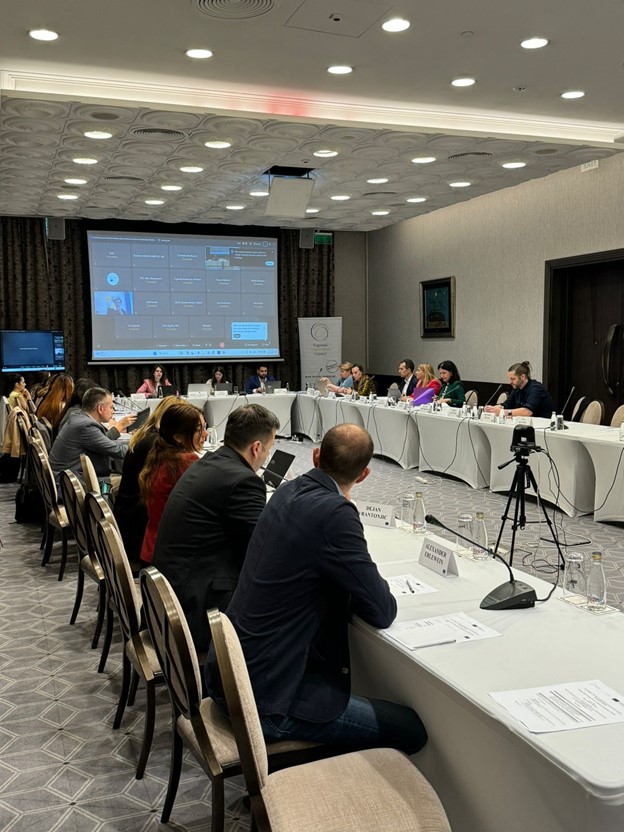
The Regional Cooperation Council (RCC) organised the first meeting of the Western Balkans Green and Circular Economy Stakeholder Platform held in Podgorica on 16 May 2024 (Photo: RCC)
Podgorica - The Regional Cooperation Council (RCC) organised the first meeting of the Western Balkans Green and Circular Economy Stakeholder Platform held in Podgorica on 16 May 2024.
Opening the meeting Ivana Markovic Boskovic, RCC Senior Expert on the Green Agenda for the Western Balkans introduced the Platform`s concept and participants, in addition, she noted that the aim of the first meeting is to deliberate on future directions, and agree on key priority topics.
Orla Farrell, DG NEAR European Commission underscored the importance of advancing implementation of circular economy (CE) implementation in the Western Balkans Six (WB6). She noted that investment in circular models for waste management is essential to unlock the potential of transforming waste into valuable secondary resources, in this regard the European Investment Plan is a crucial tool in financing flagship projects in this area. Orla Farrel highlighted that DG NEAR in partnership with the Regional Cooperation Council is supporting the Western Balkans Green and Circular Economy Stakeholders Platform.
Yousra Asbouni, Administrator, Single Market, Production and Consumption unit, European Economic and Social Committee (EESC) stressed gender equality as crucial for the Platform's success and the promotion of CE and green transition. She presented the model of the European Circular Economy Stakeholder Platform as a dynamic platform fostering stakeholder engagement, knowledge sharing, and business model information through events like European Circular Talks and conferences.
The WB6 Chambers of Commerce underscored the importance of awareness and capacity-building in the CE, advocating for closer collaboration with academia and the promotion of CE Hubs. They highlighted the challenge of decarbonization and the necessity of maintaining regional economic competitiveness and competitiveness at the EU market, particularly with the impending implementation of the Carbon Border Adjustment Mechanism (CBAM) in 2026. Shifting the energy mix poses significant challenges for many Western Balkan enterprises, prompting a focus on applying CE principles as a more feasible alternative. The Chambers also explained their activities and stressed the need for further activities to assist companies in developing clean industrial supply chains, which involves managing resources effectively and efficiently handling waste.
Participants acknowledged a significant awareness gap, with 64% of the private sector unfamiliar with CE concepts. They agreed on the need for concerted efforts to raise awareness about CE, launch educational initiatives on its benefits and principles, develop CE business models, improve recycling capabilities with appropriate machinery, and foster collaboration with regional partners to exchange knowledge and best practices. In this regard, Kristina Kuzeska, manager at Economic chamber of North Macedonia noted that WB6CIF has organized several online events to educate the private sector about CBAM, providing extensive information to businesses.
Ivana Markovic Boskovic and Hristina Stevanovic Carapina, RCC consultant presented the draft Regional Action Plan for implementing the Joint Statement on Preventing Plastic Pollution, including Marine Litter. The Plan integrates the principles of the European Strategy for Plastics in a Circular Economy which promotes the production of plastics through innovative and sustainable manufacturing that integrates circular design, which respects and enables reuse, repair, and recycling to increase jobs and reduce plastic consumption.
In the first meeting of the Western Balkans Green and Circular Economy Stakeholders Platform there were 43 participants in person and online including RWG GAWB members, WB6 public officials from line ministries of Environment and Economy, GIZ, WB6 Chambers of Commerce, WB6 Chamber Investment Forum (WB6CIF),UNDP, International Union for Conservation of Nature (IUCN) and the European Commission.