

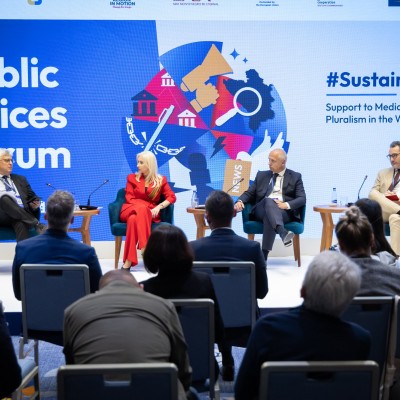
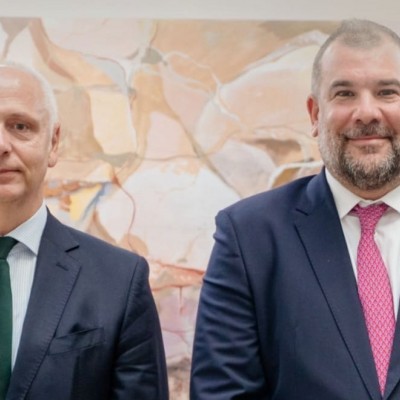
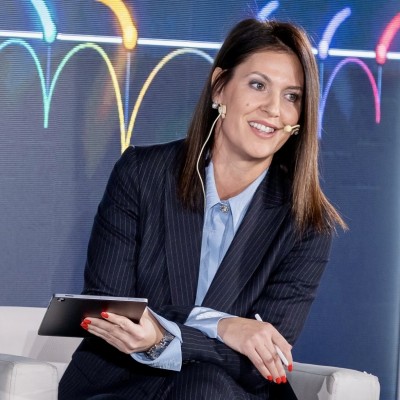
Western Balkans Six Stakeholders Platform advances regional EPR framework and action on single-use plastics
23 June 2026
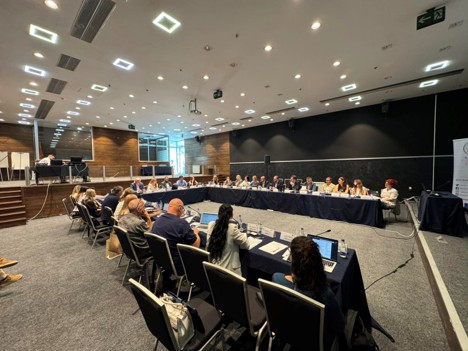
The Second meeting of the Western Balkans Six (WB6) Green and Circular Economy Stakeholders Platform in Budva on 23 June 2026 (Photo: RCC)
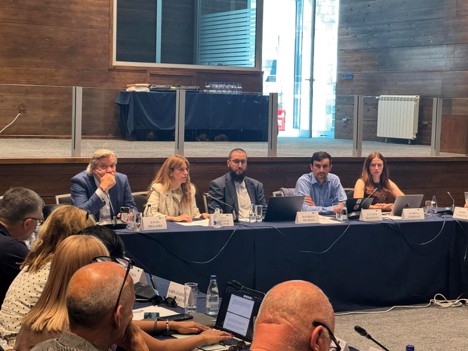
Ivana Markovic Boskovic, RCC’s Green Agenda for the Western Balkans Coordinator opening the Western Balkans Six (WB6) Green and Circular Economy Stakeholders Platform meeting on 23 June 2026 (Photo: RCC)
Budva - The Regional Cooperation Council (RCC) convened the second meeting of the Western Balkans Six (WB6) Green and Circular Economy Stakeholders Platform in Budva on 23 June 2026. Organised with the financial support of the Government of Switzerland, the meeting served as a working-level and validation forum for two regional circular economy deliverables under the Revised Green Agenda for the Western Balkans Action Plan: the WB6 Harmonised Extended Producer Responsibility (EPR) Framework for Plastic Packaging and the Regional Pledge on Phasing out the Five Most Littered Single-Use Plastic (SUP) Products.
Opening the meeting, Ivana Markovic Boskovic, RCC’s Green Agenda Coordinator, highlighted the importance of the discussion in the context of Montenegro’s chairmanship of the Berlin Process and the preparation of deliverables for the forthcoming Green Agenda ministerial process and Berlin Process Summit. “We are also focused on preparing two deliverables in the area of circular economy for this year’s summit, as well as a Green Agenda ministerial meeting where environmental ministers will endorse those deliverables that will be further confirmed by the leaders of the Western Balkans Six,” said Markovic Boskovic.
The meeting brought together representatives of WB6 governments and relevant ministries, including members of the Regional Working Group on the Green Agenda for the Western Balkans, the WB6 Chamber Investment Forum (WB6 CIF), the Network of Associations of Local Authorities of South-East Europe (NALAS), private sector representatives, development partners, international organisations and circular economy experts. Discussions focused on moving from legislative and policy commitments towards operational systems, stronger enforcement, infrastructure investment, reliable data and commercially viable circular solutions.
Against the backdrop of geopolitical instability, resource scarcity and growing climate pressures, the circular economy is increasingly recognised not only as an environmental necessity, but also as a blueprint for strengthening economic resilience and competitiveness. In this context, the planned regional deliverables on Extended Producer Responsibility for plastic packaging and the phasing out of priority single-use plastic products represent important steps towards the Western Balkans’ continued alignment with the European Union acquis.
Nils Krauer, Deputy Head of Cooperation at the Embassy of Switzerland in Bosnia and Herzegovina, underlined that circularity should be viewed as both an environmental and economic priority. “The circular economy is not only an environmental necessity, it is also an economic opportunity. It strengthens competitiveness, fosters innovation, creates new jobs, and builds more resilient and future-oriented economies across the Western Balkans and beyond,” said Krauer.
David Piegazki, Secretary General of the WB6 CIF, stressed the need for clarity and practical solutions for businesses facing rapidly evolving green requirements. “Let’s bring the light in the black box, create really sustainable databases. We really need to create some sustainable solutions,” said Piegazki, adding that the pressure on businesses is high and that they need a clear implementation route.
Maria Nikolopoulou, member of the European Circular Economy Stakeholder Platform and the European Economic and Social Committee, emphasised that EPR needs to be designed as a trusted governance instrument with transparent rules, reliable data, fair cost allocation and the meaningful participation of all relevant actors. “Extended producer responsibility is not only a technical instrument, it’s a governance tool and it can help operationalise the polluter pays principle and internalise the externality costs precisely for the environment,” said Nikolopoulou.
Alexander Batteiger, Head of the PREVENT Waste Alliance Secretariat, shared international experience from the Global Action Partnership for Extended Producer Responsibility Helpdesk. “If you work on EPR policies, do not forget to actually do something on the ground, because the policy instrument will not change realities immediately. It’s a two- to five-year process to see changes and to get collection rates,” said Batteiger. He also stressed that EPR requires political backing, adequate monitoring resources and a manageable initial scope, and that it forms only one part of a broader circular economy policy mix.
The draft WB6 EPR Framework presented at the meeting proposes a harmonised core covering definitions, producer registration, placed-on-market data, monitoring, reporting and verification, producer responsibility organisation governance, cost coverage, fee-setting, eco-modulation, transparency, audit, controls against free-riding and common performance indicators. Flexibility would remain for the institutional and market arrangements applied in each of the WB6. Participants validated the main components through a structured digital matrix and provided comments to be incorporated into the final phase.
The meeting also reviewed the regional analysis underpinning coordinated action on five priority SUP product groups: lightweight plastic carrier bags, beverage containers, cups for beverages, food containers, and single-use cutlery and stirrers. Participants stressed that restrictions must be accompanied by viable alternatives, source separation, functioning EPR and deposit return systems, reuse and refill models, market surveillance, public awareness and investment in collection, sorting and recycling infrastructure.
The participants agreed that the Platform should increasingly operate as a delivery mechanism, facilitating peer learning, targeted capacity-building, study visits and the development of scalable and investment-ready projects. Priorities for follow-up include interoperable producer registries, harmonised indicators, secondary raw material markets, intraregional circular value chains, industrial symbiosis, support to small and medium-sized enterprises, and a potential regional strategic investment pipeline.
41 participants took part in the meeting, representing WB6 ministries and institutions, chambers of commerce, local authorities, businesses, regional organisations and development partners. Established in 2024 by the RCC and the WB6 CIF, the Platform connects public authorities, the private sector, academia, civil society and international partners to support coordinated and practical delivery of the circular economy pillar of the Green Agenda for the Western Balkans.