

RCC organises the Extended Meeting of the Regional Working Group on the Green Agenda for the Western Balkans (RWG GAWB) on the Water and Sanitation Sector
27 November 2025
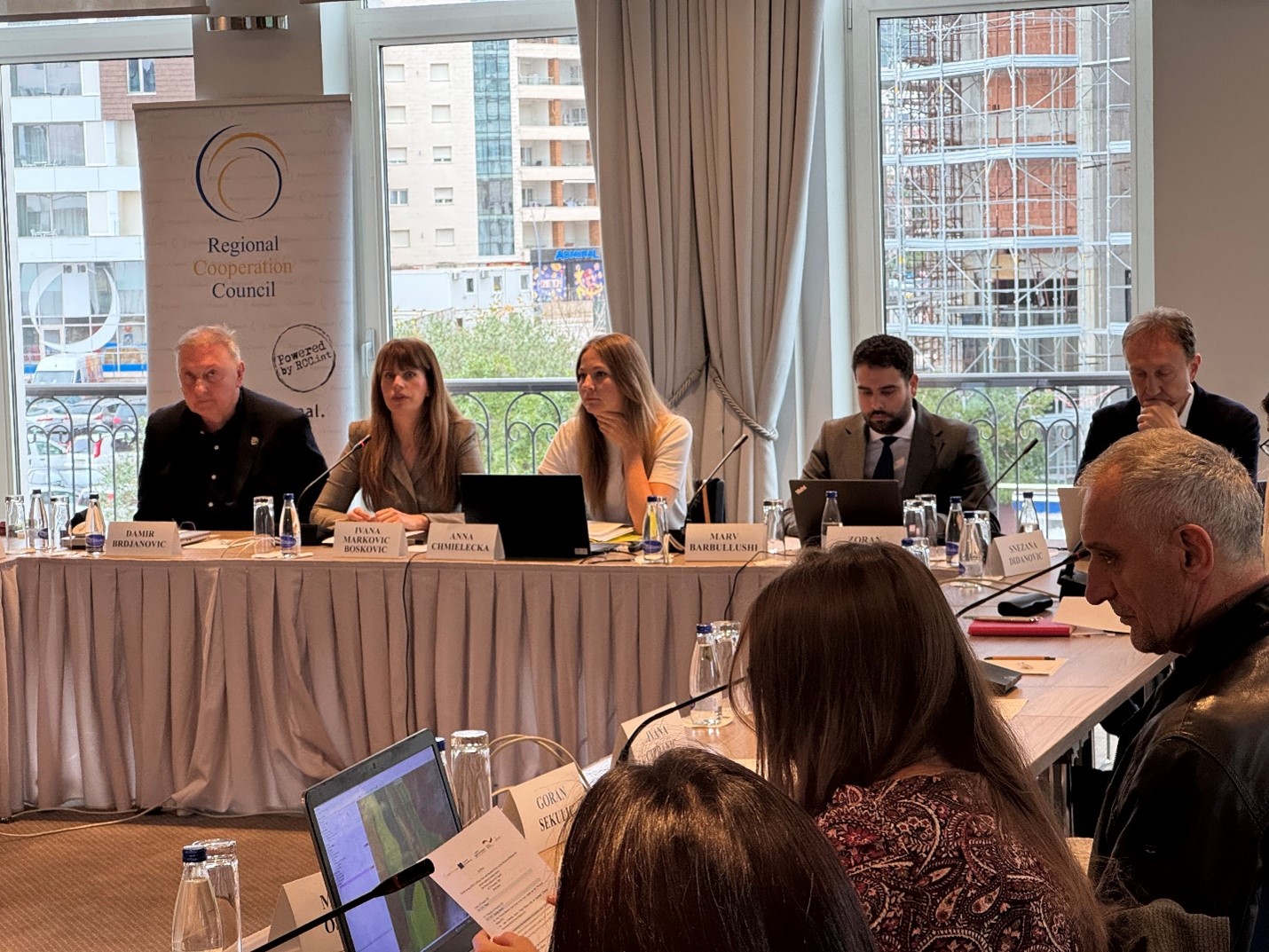
Extended Meeting of the Regional Working Group on the Green Agenda for the Western Balkans (RWG GAWB) on the Water and Sanitation Sector in the WB6, held in Budva on 26 and 27 November 2025
Budva - The Regional Cooperation Council (RCC) organised the Extended Meeting of the Regional Working Group on the Green Agenda for the Western Balkans (RWG GAWB) on the Water and Sanitation Sector in the Western Balkans Six (WB6), held in Budva on 26 and 27 November 2025. RCC organised the meeting with the support of the Deutsche Gesellschaft für Internationale Zusammenarbeit (GIZ) under the Regional Climate Partnership and IHE Delft Institute for Water Education.
Opening the meeting, Ivana Markovic Boskovic, RCC’s Senior Expert and Coordinator of the Green Agenda, highlighted that water is a priority topic as it intersects with all pillars of the Green Agenda. She emphasised the need to align the WB6 with the European Water Resilience Strategy. “Green Agenda regional documents, such as the Climate Adaptation Strategy and the Biodiversity Strategic Plan, are interlinked, with nature-based solutions (NbS) playing a key role in flood management and other water-related priorities,” said Ivana Markovic Boskovic.
Anna Chmielecka, Advisor for Climate Dialogue within the Regional Climate Partnership with the Western Balkans, GIZ, presented the Regional Climate Partnership (RCP) and its relevance to the Berlin Process framework and support for the implementation of the GAWB. She noted the importance of water depollution and briefly described the GIZ Regional Capacity Development Network for Water and Sanitation Services (RCDN).
RWG members were presented with two keynote presentations from IHE Delft. Mr Zoran Vojinovic, Associate Professor of Urban Water Systems at the Water Supply, Sanitation and Environmental Engineering Department, presented climate-resilient aspects of water management, noting the increasing rates of floods and droughts in Europe, including the WB6, and the challenges in building the necessary infrastructure, including small- and large-scale nature-based solutions (NbS) for hydro-meteorological risk reduction. He underlined the importance of digitalisation, data science and AI, as well as creating a new generation of knowledge providers with water-related skills to address these challenges.
Mr Damir Brdjanovic, Professor of Sanitary Engineering at IHE Delft, presented on capacity development in the water and sanitation sector. He explained in detail the importance of water skills for the WB6 and provided a brief description of the Global Sanitation Graduate School and the main online courses available to all. Together with Mr Vojinovic, he engaged participants in an active discussion, gathering feedback on short courses for water sector upskilling and exploring the development of a master’s programme focusing on the WB6.
The extended meeting gathered 55 participants, including RWG GAWB members, WB6 public officials from water agencies and bodies working on water-related policy areas, academia, IHE Delft, GIZ, and others.
Established in April 2023 through the transformation of the former RWG on Environment, the RWG GAWB provides the operational framework necessary to effectively fulfil its mandate under the Green Agenda for the Western Balkans Action Plan. It serves as the core intergovernmental coordination platform, composed of senior representatives from the WB6 ministries responsible for climate and environment. It represents the backbone of the GAWB implementation process, ensuring technical coordination, facilitating regional dialogue and monitoring progress against the commitments of the Sofia Declaration.