

RCC Board accepts Annual Report, commends the work of the organisation and discusses next steps for South East Europe’s regional cooperation agenda
14 May 2026
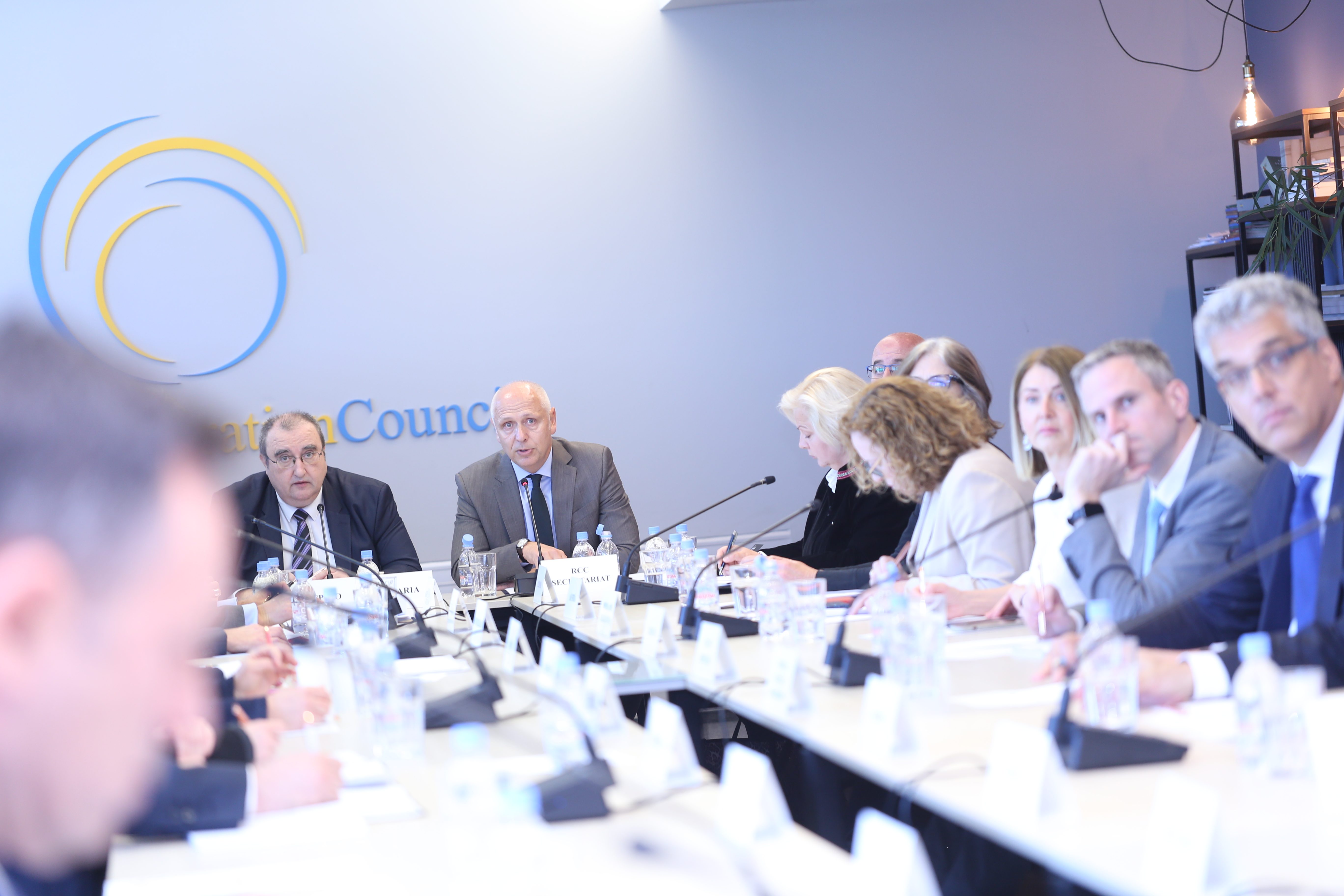
RCC Secretary General chairing 59th RCC Board meeting, in Sarajevo on 14 May 2025 (Photo: RCC/Jasmin Sakovic)
Sarajevo – The Regional Cooperation Council (RCC) Board met today in Sarajevo for its 59th meeting, reviewing the RCC Annual Report for the period June 2025-June 2026 and discussing key regional cooperation priorities for the period ahead, including the Common Regional Market, SEE2030, Green Agenda, security cooperation, and disaster financial risk sharing in South East Europe.
The meeting, chaired by RCC Secretary General Amer Kapetanović, brought together RCC Board Participants to take stock of the Secretariat’s work over the past year and exchange views on the implementation of the RCC Strategy and Work Programme 2026-2028. The Board reviewed and accepted the draft RCC Annual Report, which will be presented at the SEECP MFA Ministerial Meeting and the SEECP Summit in June. The report reflects a year of strengthened delivery, an increased focus on measurable regional impact, and continued RCC support for South East Europe’s regional cooperation agenda. Board participants commended the results achieved by the organisation under the leadership of RCC Secretary General Amer Kapetanović, recognising the Secretariat’s stronger focus on implementation, delivery, and tangible regional impact.
“Regional cooperation is strongest when it delivers visible, practical results. Over the past year, RCC has worked to turn political commitments into operational tools, measurable progress and concrete regional outcomes, from the Common Regional Market and Green Agenda to SEE2030, security cooperation and resilience. Our task now is to keep this agenda moving with discipline, transparency and shared ownership, because the credibility of regional cooperation depends on implementation,” said RCC Secretary General Amer Kapetanović.
The Board also reviewed progress under the Common Regional Market, including ongoing work on the 2026 deliverables planning cycle under the Berlin Process and the development of the CRM Monitoring Tool, which is being prepared jointly with CEFTA and in partnership with the Transport Community, Energy Community and WB6 CIF.
A dedicated discussion was held on SEE2030, following the recent endorsement of three core deliverables: the SEE2030 Mid-Term Update, the SEE2030 Mid-Term Implementation Report, and the SEE Inclusive Growth Index Report. These documents provide both a stocktake of implementation progress since 2021 and a strategic orientation for the next phase of the SEE2030 Strategy, with a stronger focus on resilience, inclusive growth and regional cooperation.
The Board was also briefed on the implementation of the RCC Board Decision approving the Project Synopsis on Disaster Financial Risk Sharing in South East Europe. Following the decision adopted in March, the RCC initiated technical, analytical and coordination activities, including initial consultations with the European Commission, Frankfurt School of Finance and Management, EIOPA, the European Investment Bank, UNDP and the World Bank, with discussions focused on the launch of a feasibility study and technical assistance component.
The meeting also touched upon the broader regional calendar ahead, including upcoming ministerial meetings and sectoral events linked to the Berlin Process, as well as preparations for the RCC Annual Meeting, scheduled for 9 June, and the SEECP Ministerial and Summit, scheduled for 10 June 2026 in Sofia, as part of the South East European Cooperation Process (SEECP) framework.
A presentation was delivered on the work of South Eastern and Eastern Europe Clearinghouse for the Control of Small Arms and Light Weapons (SEESAC), region’s platform for strengthening the control and reduction of small arms and light weapons and fostering regional cooperation, with Secretary General Amer Kapetanović commending its longstanding work as a role model for similar initiatives worldwide and reaffirming RCC’s strong support for its mission.
The 59th RCC Board meeting was preceded by the 49th Coordination Meeting between the SEECP Troika, the RCC and the European Union, as well as a Briefing on the implementation of the Common Regional Market 2 Action Plan.