


RCC presents Methodology for Western Balkans Six Climate Adaptation Strategy Development
26 March 2026
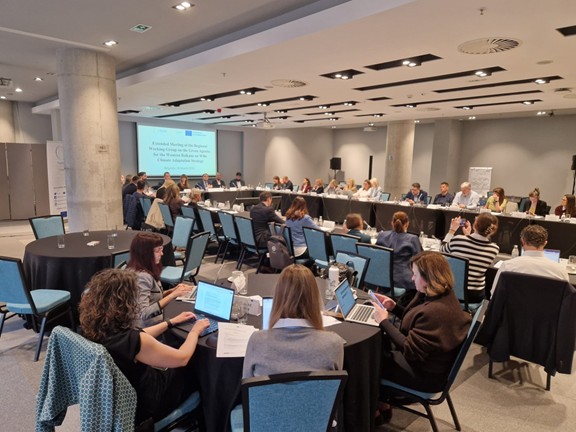
Participants of the Extended Meeting of the Regional Working Group on the Green Agenda for the Western Balkans on WB6 Climate Adaptation Strategy, 26 March 2026 (Photo: RCC)
Belgrade - The Regional Cooperation Council (RCC) presented the methodology for developing the Western Balkans 6 (WB6) Climate Adaptation Strategy at the Extended Meeting of the Regional Working Group on the Green Agenda for the Western Balkans (RWG GAWB), held in Belgrade on 26 March 2026. The RCC organised the meeting with the support of the Organization for Security and Co-operation in Europe (OSCE) and Deutsche Gesellschaft für Internationale Zusammenarbeit (GIZ) under the Regional Climate Partnership.
Opening the meeting, Ivana Markovic Boskovic, RCC’s Senior Expert on Green Agenda and Coordinator of the Green Agenda, emphasised that climate adaptation is not a choice but essential for economic stability and social resilience of the region, noting that investments in climate adaptation can generate significant long-term savings while protecting lives and natural resources. “With an estimated EUR 32 billion needed over the next decade, timely and effective action could generate up to USD 64 billion in annual savings by 2050, while safeguarding lives, livelihoods, and natural resources,” said Ivana Markovic Boskovic.
The Strategy aims to strengthen the Western Balkans’ resilience to climate change by mid-century in line with the EU Adaptation Strategy and the Green Agenda for the Western Balkans. Discussions highlighted the need for improved climate data and monitoring systems, better integration of climate and disaster risk management, and stronger links between science, policy, and financing to support adaptation measures.
Jose Luis Masegosa Carrillo, International Relations Officer, DG ENEST extended European Commission’s support to the Western Balkans Six by sharing expertise, strengthening capacities, and investing in infrastructure that can withstand climate impacts.
“Climate change is already affecting the region, with visible consequences for people, ecosystems, and economies. Developing a regional adaptation strategy is a crucial step towards effectively responding to these growing challenges,” said Alexander Erlewein, Project Manager from GIZ.
“Climate risks are shared across borders, and so must be the solutions. Regional cooperation is essential not only for building resilience but also for maintaining security. The WB6 Adaptation Strategy reflects a shared understanding that climate adaptation in South-Eastern Europe requires a coordinated regional approach,” said Thomas Ritzer, Senior Advisor on Climate Change and Security, who also leads the Climate Change Team at the OSCE, concluding the opening remarks.
The participants concluded that the inputs gathered during the meeting will feed into the first draft of the WB6 Climate Adaptation Strategy. Participants also agreed on next steps towards finalising and endorsing the Strategy, ahead of the upcoming Green Agenda Ministerial meeting planned for September 2026 in Montenegro.
The discussions brought together 44 participants, including RWG GAWB members, WB6 public officials working on climate adaptation, hydrometeorological institutes responsible for early warning systems, and disaster risk reduction authorities. The European Commission, GIZ and OSCE also contributed insights from their climate adaptation work in the region.
***
Established in April 2023 following the transformation of the former RWG on Environment, the RWG GAWB provides the operational framework for implementing the Green Agenda for the Western Balkans Action Plan. As the core intergovernmental coordination platform, it brings together senior representatives from Western Balkans Six ministries responsible for climate and environment, ensuring technical coordination, facilitating regional dialogue, and monitoring progress under the Sofia Declaration.