

Documents & Publications
Balkan Barometer 2025: Public opinion
01 SEPTEMBER 2026 | SURVEY
Since its launch in 2015, Balkan Barometer has become the most comprehensive regional perception survey in the Western Balkans Six, providing comparable data across jurisdictions and over time. The survey offers an evidence base for policymakers, researchers, businesses and international partners seeking to understand key economic and societal developments in the region.
The 2025 Balkan Barometer surveys were conducted between 21 May and 30 June 2025 across the WB6. The Public Opinion Survey interviewed 6,012 citizens through 39 main questions, and was conducted by Consulting Group, NUIS.
Download: EN
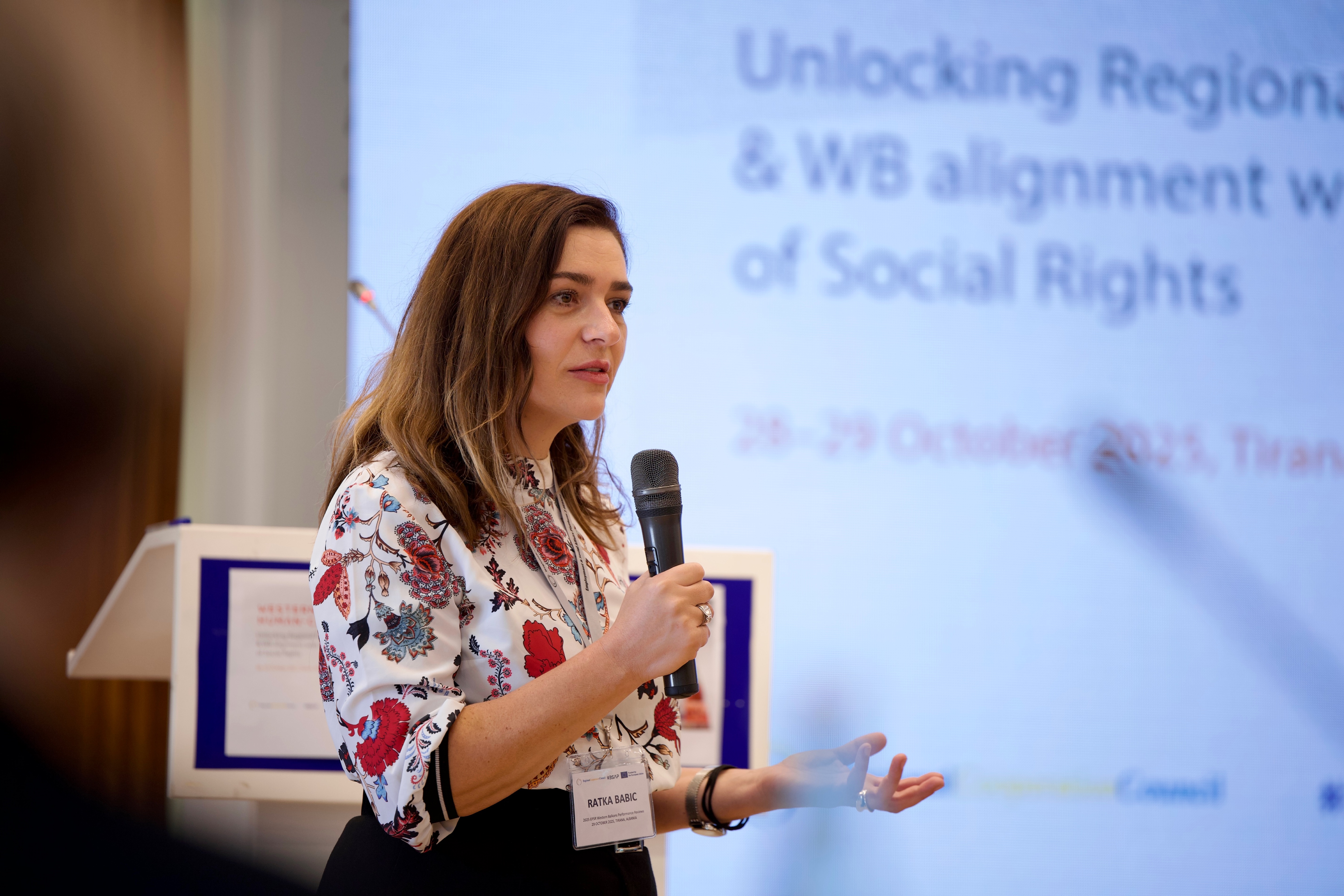
Op-ed by Ratka Babic, RCC's ESAP Team Leader: May Day in the Age of AI: Progress Must Be People-centred
30 APRIL 2026 | ARTICLE
The op-ed on the occasion of the the International Workers Day says that despite rapid technological advances - especially in artificial intelligence - work has not become easier or more humane, and instead often stretches further into people’s lives. Framed around the significance of May Day, it questions whether progress truly benefits workers or merely boosts efficiency, highlighting issues like job displacement, blurred work-life boundaries, and structural labour challenges in Europe and the Western Balkans. It stresses that AI brings hidden economic, social, and environmental costs, and warns that without deliberate policy choices—such as investing in skills, improving job quality, and rethinking working time—technological progress could undermine social stability. It calls for a people-centred approach to the future of work, where innovation serves human well-being, dignity, and quality of life rather than diminishing them.
RCC ESAP 3: Performance of the Western Balkan Six Regarding the European Pillar of Social Rights – 2025 Review on Albania
29 OCTOBER 2025 | REPORT
Albania has entered a new phase of convergence with the European Pillar of Social Rights (EPSR), underpinned by steady economic growth, modernised labour legislation, and a comprehensive set of strategic reforms.
Download: EN
RCC ESAP 3: Performance of the Western Balkan Six Regarding the European Pillar of Social Rights – 2025 Review on Bosnia and Herzegovina
29 OCTOBER 2025 | REPORT
The 2025 Review on Bosnia and Herzegovina’s performance in implementing the European Pillar of Social Rights (EPSR) provides a comprehensive and data-driven assessment of the Bosnia and Herzegovina social policy developments, institutional capacities, and progress towards EU alignment. Conducted in the context of Bosnia and Herzegovina’s advancement to EU candidate status in December 2022, this Review is of strategic importance for evaluating the readiness of Bosnia and Herzegovina to engage in formal accession negotiations.
Download: EN
RCC ESAP 3: Performance of the Western Balkan Six Regarding the European Pillar of Social Rights – 2025 Review on Kosovo*
29 OCTOBER 2025 | REPORT
Kosovo* has made moderate, though uneven progress in aligning its policies and practices with the European Pillar of Social Rights (EPSR). Since 2021, the government has adopted reforms in social protection, employment activation, and child and family support, while also piloting innovative schemes such as the Youth Guarantee Scheme. However, significant structural challenges persist, including high informality, under-resourced institutions, and limited data collection mechanisms.
Download: EN
RCC ESAP 3: Performance of the Western Balkan Six Regarding the European Pillar of Social Rights – 2025 Review on Montenegro
29 OCTOBER 2025 | REPORT
Montenegro has made notable, albeit uneven, progress in implementing the principles of the European Pillar of Social Rights (EPSR), especially in the context of ongoing EU integration and reform efforts. Over the past two years, a number of strategic reforms have been launched, reflecting a stronger political commitment to align policies with EU social standards.
Download: EN
RCC ESAP 3: Performance of the Western Balkan Six Regarding the European Pillar of Social Rights – 2025 Review on North Macedonia
29 OCTOBER 2025 | REPORT
The European Pillar of Social Rights (EPSR) Review 2025 provides an in-depth evaluation of North Macedonia’s progress in aligning with the 20 principles of the Pillar. It reveals a mixed picture of social and labour market developments: sustained legislative activity and targeted reforms are gradually transforming key social systems, yet persistent structural barriers, especially related to youth employment, informality, education mismatches and social inclusion, continue to hinder full convergence with EU standards.
Download: EN
RCC ESAP 3: Performance of the Western Balkan Six Regarding the European Pillar of Social Rights – 2025 Review on Serbia
29 OCTOBER 2025 | REPORT
In relation to the European Union (EU) standards, Serbia performs below average or poorly in most of the reviewed principles and policies that are part of the European Pillar of Social Rights (EPSR). While a good part of this overall assessment logically follows from the fact that Serbia is, in terms of the level of economic development, poorer than any EU Member State, in some aspects the assessment is related
to policy choices – either from the relatively distant or more recent past, that are not conducive to the flourishing of social rights as envisaged in the EPSR.
Download: EN
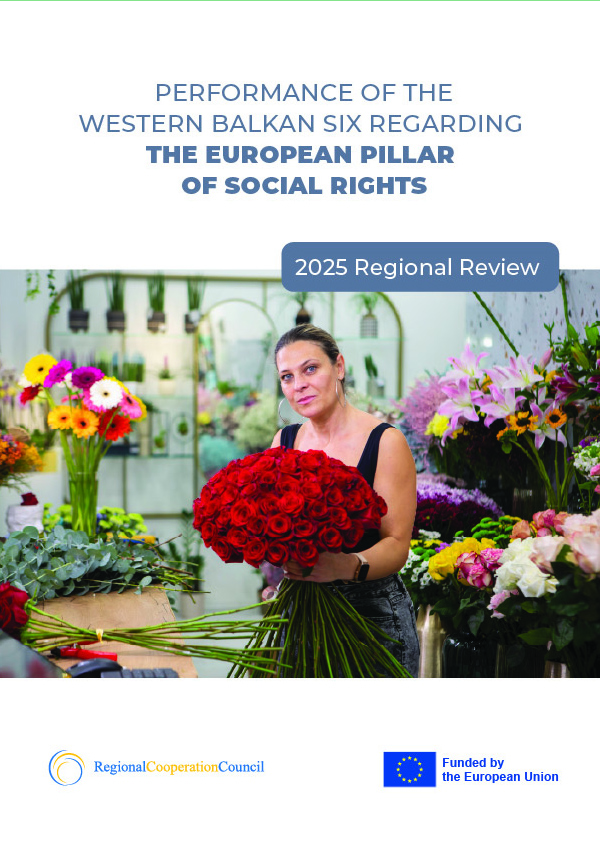
RCC ESAP 3: Performance of the Western Balkan Six Regarding the European Pillar of Social Rights – 2025 Regional Review
29 OCTOBER 2025 | REPORT
This 2025 review of the performance of the Western Balkan Six (WB6) regarding the European Pillar of Social Rights (EPSR) has been conducted by the Employment and Social Affairs Platform 3 (ESAP 3) project, jointly implemented by the Regional Cooperation Council (RCC) and the International Labour Organisation (ILO), and funded by the European Union (EU). It builds upon assessments carried out in
previous years and includes updated information from 2023 to 2025.
Download: EN

Annual Report of the RCC Secretary General 2024-2025
15 JUNE 2025 | REPORT
The Annual Report of the Secretary General of the Regional Cooperation Council (RCC) covers the period June 2024 – June 2025. It outlines main RCC activities and achievements in the past year. It also lays out the overall background and crucial developments impacting and shaping the activities of the RCC and the region of South East Europe in the reporting period.
Download: EN
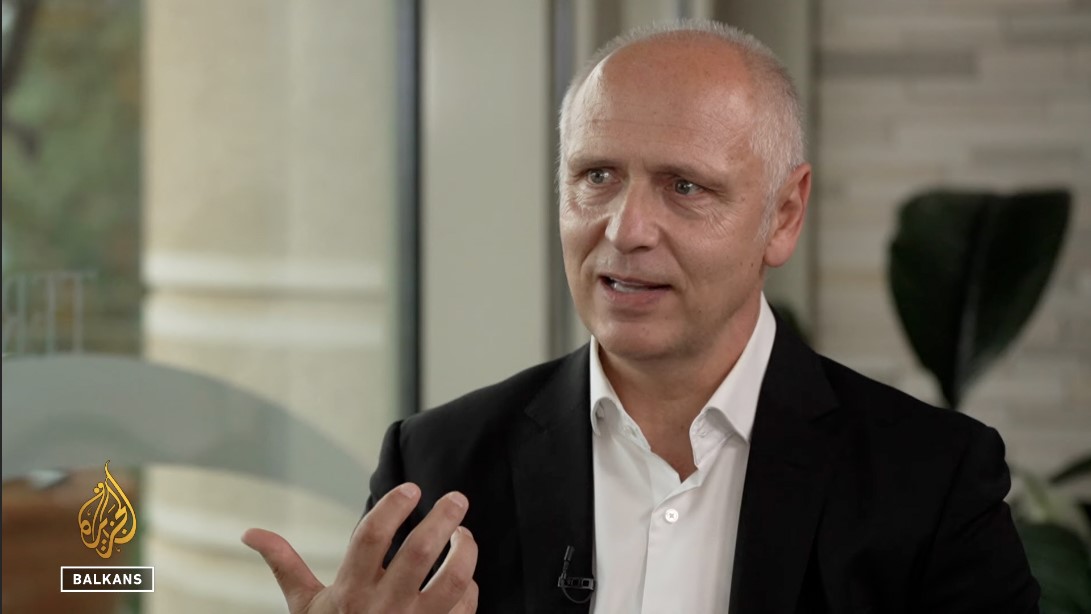
RCC SG for Al Jazeera Balkans
22 MAY 2025 | INTERVIEW
RCC Secretary General Amer Kapetanovic spoke for Al Jazeera Balkans' "Recite Al Jazeeri" (Tell Al Jazeera) show. Kapetanovic spoke regional employment and workforce dynamics, Common Regional Market and the challenges and potential of power of regional cooperation for the Western Balkans and South East Europe.
Entire interview in Bosnian language is below.
Download: BS
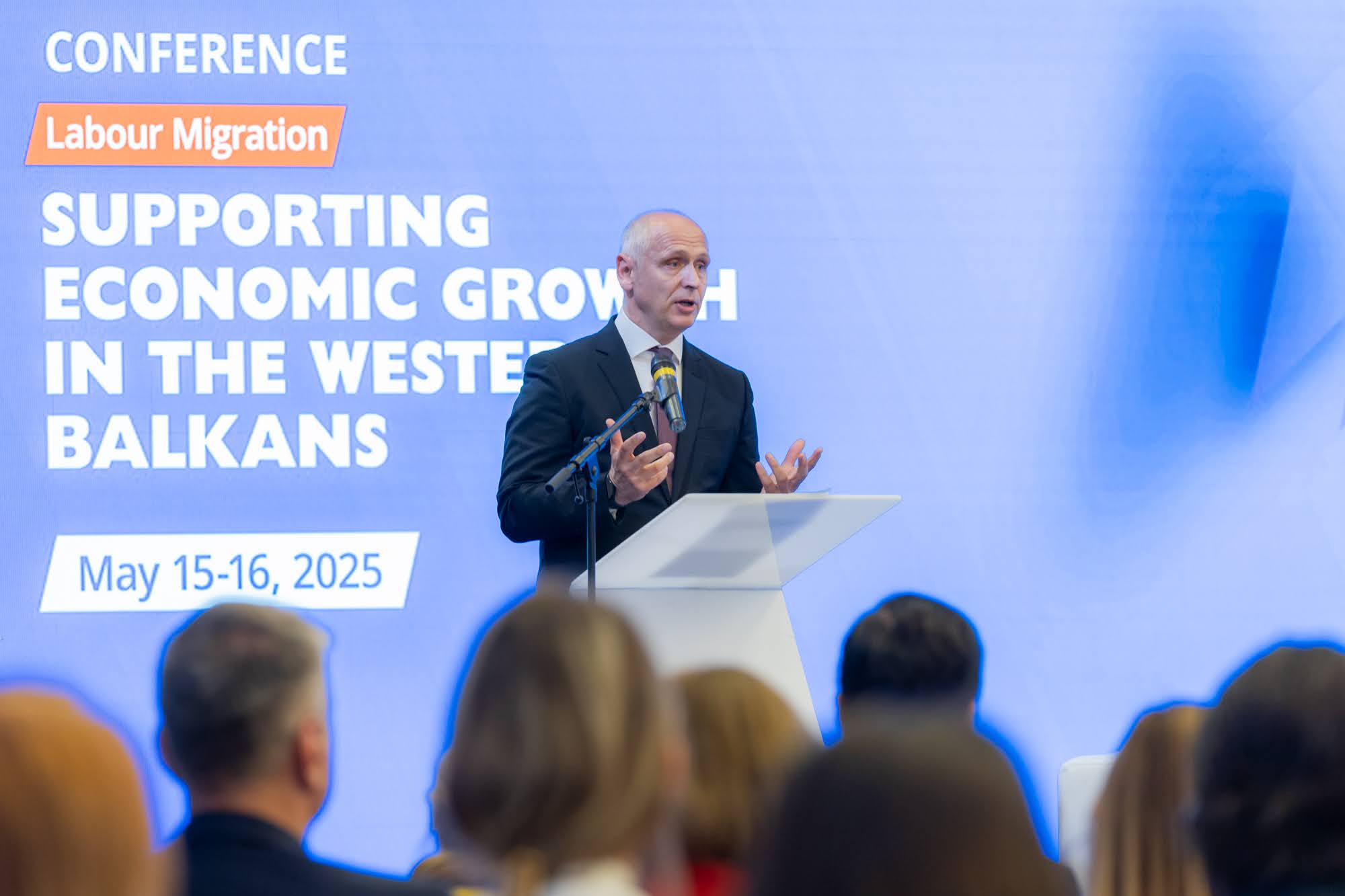
Speech by RCC Secretary General at the Conference on Labour Migration: Supporting Economic Growth in the Western Balkans
15 MAY 2025 | SPEECH
RCC Secretary General opened Amer Kapetanovic opened High-level Conference on Labour Migration: Supporting Economic Growth in the Western Balkans, held in Budva, Montenegro on 15 May 2025.
Addressing the urgent need for a collaborative transition and the Western Balkans' need to shift from fragmented, reactive migration policies to a coordinated, strategic framework for labour mobility that effectively balances retaining local talent with attracting ethical, well-managed labour immigration to tackle workforce shortages and drive regional growth and EU integration, Kapetanovic said: “Labour migration is no longer something we can plan for tomorrow, it is already reshaping our societies today. In just five years, the number of work permits issued to foreign workers in the Western Balkans has more than doubled, from 46,000 in 2018 to over 100,000 in 2023. At the same time, employers across the region are struggling to fill vacancies, while our own citizens remain in demand abroad. This dual reality calls for smart, inclusive, and human-centred policies. At RCC, we believe migration done right can bridge skills gaps, energise our economies, and restore dignity to work. That’s why we are investing in regional frameworks that align with EU standards, protect workers’ rights, and give people, whether they were born here or just arrived, a fair chance to build a life."
Download: EN

Op-ed by RCC Secretary General Amer Kapetanovic: Dignity at Work in the Age of Disruption
30 APRIL 2025 | ARTICLE
The Op-ed by RCC Secretary General Amer Kapetanović reflects on International Workers’ Day as a call to uphold the dignity of work amid the profound transformations reshaping the global labor landscape. It highlights how technological disruption, green transitions, and AI are challenging traditional work structures and blurring work-life boundaries, necessitating a redefinition of workers’ rights and conditions. Focusing on the Western Balkans, the piece acknowledges economic improvements like rising employment but warns of deep-seated issues such as talent outflow, skills mismatches, informal labor, and policy gaps. Ultimately, it argues that ensuring dignified, fair, and meaningful work is essential not just for economic resilience but for preserving human dignity in a rapidly changing world.
Annual Report of the RCC Secretary General 2023-2024
13 JUNE 2024 | REPORT
The Annual Report of the Secretary General of the Regional Cooperation Council (RCC) covers the period May 2023 – May 2024. It outlines main RCC activities and achievements in the past year. It also lays out the overall background and crucial developments impacting and shaping the activities of the RCC and the region of South East Europe in the reporting period.
Download: EN

Painting the Western Balkans’ Labour Markets in Brighter Colours - Op-Ed by the Secretary General of the Regional Cooperation Council Majlinda Bregu
16 MARCH 2024 | ARTICLE
Op-ed by Secretary General of the Regional Cooperation Council Majlinda Bregu discusses the evolving labor market trends in the Western Balkans, highlighting a decrease in unemployment rates but also pointing out significant challenges such as skill shortages, emigration of talented workers, and disparities in vocational education participation. It emphasizes the importance of addressing these challenges through targeted interventions, particularly in vocational education and training (VET), to align with industry needs and retain talent within the region.
The article calls for collaborative efforts among governments, businesses, and civil society to develop comprehensive strategies to foster innovation, productivity, and economic growth in the Western Balkans.
Aligning Western Balkan Labour Market Policy Databases with the EU Guidelines
30 NOVEMBER 2023 | REPORT
The report Aligning Western Balkan Labour Market Policy Databases with the EU Guidelines offers a brief regional overview of current practices in the Western Balkans, as well as a comprehensive assessment of each economy’s practices, accompanied by data and recommendations that will help to advocate for labour market and social policy reforms to improve the employment opportunities and working conditions of citizens in the region, as well as enhancing the capacity of institutional stakeholders to align their practices in this area with the EU.
Download: EN
Annual Report of the Secretary General of the Regional Cooperation Council 2022-2023
27 JUNE 2023 | REPORT
This Annual Report of the Secretary General of the Regional Cooperation Council (RCC) covers the period April 2022 – April 2023. It outlines main RCC activities and achievements in the past year. It also lays out the overall background and crucial developments impacting and shaping the activities of the RCC and the region of South East Europe in the reporting period.
Annual Report of the Secretary General of the Regional Cooperation Council 2022-2023 has been adopted at the SEECP Summit held in Budva on 5 June 2023.
Download: EN
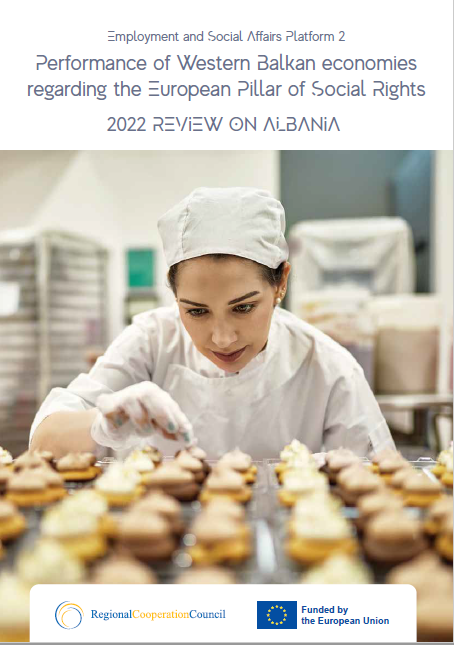
RCC ESAP 2: Performance of Western Balkan Economies Regarding the European Pillar of Social Rights: 2022 review on Albania
28 APRIL 2023 | STUDY
Albania shows progress in almost all areas towards achieving the European standards related to the Social Rights Pillar during 2021-2022. Of particular importance is the fact that as the economy recovered and rebounded in 2021, economic inequality declined, access to the labour market improved, and the gender wage gap showed signs of narrowing. A new Strategy for Development and European Integration 2030 was adopted in 2022 to foster the integration in the region and the EU. Nevertheless, some challenges remain, especially in social sectors. Social spending in general remains low. Reasons include a limited coverage by the unemployment insurance programme as well as a limited scope of the social safety net (no guaranteed minimum income, no child or family benefits and limitations in access to health services). As a result, the percentage of population at-risk-of-poverty or social exclusion remains one of the highest in Europe.
Download: EN
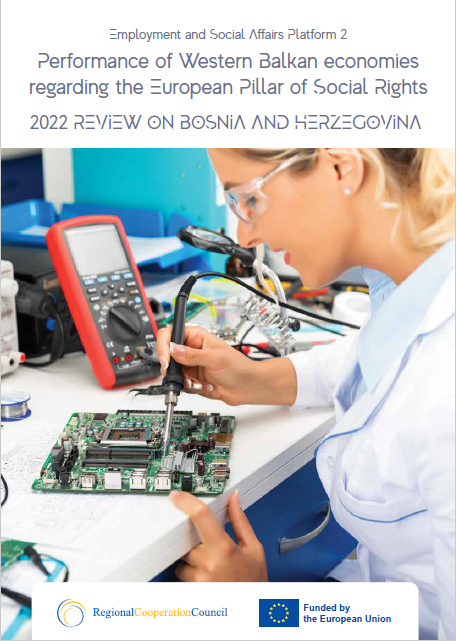
RCC ESAP 2: Performance of Western Balkan Economies Regarding the European Pillar of Social Rights: 2022 review on Bosnia and Herzegovina
28 APRIL 2023 | STUDY
Bosnia and Herzegovina's overall progress towards the principles of the European Pillar of Social Rights remained rather modest in 2021-2022. Reforms move slowly due to the economy’s specific political structure that prolongs the design, agreement, and implementation of reforms. However, limited progress was made regarding social policy and employment. Challenges in employment, social inclusion and protection, and poverty reduction remain, the latter being intensified by the complex coordination processes among the responsible institutions across the economy. Although by law, equal access to the healthcare system is guaranteed to all citizens, in practice, accessibility of health care services is limited. The major improvements during the period under analysis are related to labour market and the overall economic development, reflected in an increased employment rate. However, youth unemployment remains high.
Download: EN

RCC ESAP 2: Performance of Western Balkan Economies Regarding the European Pillar of Social Rights: 2022 review on Kosovo*
28 APRIL 2023 | STUDY
Kosovo* showed modest progress towards reaching the European standards. The trend of economic recovery in 2022 has been coupled with progress in some indicators of the EPSR – particularly in terms of improvements in the formalisation of informal employment, strengthening the position of women in the labour market, decreasing NEET rates amongst youth, as well as in the unemployment rate compared to the previous year. However, some of these results may not be sustained considering the high level of outmigration that has continued in the last year. Additionally, Kosovo* has made progress in adopting laws in compliance with the EU Directives. Still, implementation remains very weak, especially for the labour force in the private sector. The key strategies for education, employment and social welfare have not yet reached the intended objectives.
Download: EN
RCC ESAP 2: Performance of Western Balkan Economies Regarding the European Pillar of Social Rights: 2022 review on Montenegro
28 APRIL 2023 | STUDY
Montenegro experienced little progress towards social change in line with the Pillar indicators. Some improvements exist along with the persisting challenges. Poverty and social exclusion levels, despite decreasing, remain high, especially for children, persons with disabilities, older people, Roma, and Egyptian population, and for citizens of the Northern region. Positive changes include the increased coverage of children by preschool education, decline of early school leavers, and a slight decrease in the NEET rate. Nonetheless, a comprehensive strategy on education reform is missing. Due to substantial economic growth, the unemployment rate significantly decreased in 2022 compared to 2021 and 2020. Notwithstanding, challenges of long-term unemployment and youth unemployment remain.
Download: EN
RCC ESAP 2: Performance of Western Balkan Economies Regardinf the European Pillar of Social Rights: 2022 Review on North Macedonia
28 APRIL 2023 | STUDY
North Macedonia demonstrates some progress on the EU accession path, particularly through the conduction of legislation reforms and the expansion of the social safety net. While the latter was supported by an increased fiscal space due to the post-pandemic economic recovery, progress towards improving the efficiency and effectiveness of the system is still required. As a positive development on the level of strategy, the Revised Employment and Social Reform Programme 2022 provides a good example defining priority reforms and policies in the three priority areas of labour market and employment, human capital and skills, and social inclusion and social protection. Parallelly, the new Labour Law is under way, which will introduce regulations on new forms of employment such as online work and work from home. The successful implementation of the Youth Guarantee (YG) Programme, its positive experience, and lessons learnt can be shared in the region.
Download: EN
RCC ESAP 2: Performance of Western Balkan Economies Regarding the European Pillar of Social Rights: 2022 review on Serbia
28 APRIL 2023 | STUDY
Serbia’s overall progress regarding the indicators is rather moderate. While performance in the fields of equal opportunities, fair working conditions, and social protection and inclusion remains below the EU average, progress in legislation is noticeable and largely carried out in line with the EU Acquis. For instance, the Law on Social Cards enacted in April 2022 is expected to reduce the at-risk-of-poverty rate. Furthermore, the Law of Social Entrepreneurship adapted in 2022 is expected to improve the situation on the labour market for vulnerable groups of population.
Download: EN
Regional Overview of Western Balkan Economies Regarding the European Pillar of Social Rights 2022
27 APRIL 2023 | REPORT
The overview regional report analyses the progress of six Western Balkan economies (Albania, Bosnia and Herzegovina, Kosovo*, Montenegro, North Macedonia, Serbia) regarding the 20 principles of the European Pillar of Social Rights (EPSR). The 2022 review of the performance of Western Balkan (WB) economies regarding the EPRS has been conducted by the Employment and Social Affairs Platform 2 (ESAP 2) programme implemented by the RCC and funded by the European Union. It was produced by WINS Global Consult (Germany) and experts from Western Balkans on behalf of the RCC. Individual economy reports are available on https://www.esap.online/.
*This designation is without prejudice to positions on status and is in line with UNSCR 1244/1999 and the ICJ Opinion on the Kosovo declaration of independence.
Download: EN
REPORT ON THE ACTIVITIES OF THE REGIONAL COOPERATION COUNCIL SECRETARIAT for the period 1 November 2022 – 1 March 2023
15 MARCH 2023 | REPORT
Report on the activities of the Regional Cooperation Council Secretariat for the period 1 November 2022 – 1 March 2023 was presented by the RCC Secretary General Majlinda Bregu at the 48th RCC Board meeting on 15 March 2023 in Sarajevo.
Download: EN
Women Entrepreneurship in the Western Balkans - economy factsheets
09 JANUARY 2023 | INFORMATION MATERIAL
Gender statistics play an important role for evidence-based policy making in support of women entrepreneurship. Hence, a thorough review of gender statistics in the Western Balkans, with a specific focus on “women entrepreneurship”, has been commissioned by Regional Cooperation Council. In addition, a sector review for “women in agriculture” has enriched the insights and has been included considering the strategic importance of the agro-food sector in the Common Regional Market Action Plan’s value chains.
The findings will further contribute to the discussion and work of the Regional Network of Women in Entrepreneurship.
Here is what women entrepreneurship in Albania, Bosnia and Herzegovina, Kosovo*, Montenegro, North Macedonia and Serbia looks like.

Anadolu Agency interview with RCC Secretary General dubbed "Bregu: Travel with ID cards in Western Balkans possible from 2023"
31 OCTOBER 2022 | INTERVIEW
RCC Secretary General Majlinda Bregu interview to Anadolu Agency dubbed "Bregu: Travel with ID cards in Western Balkans possible from 2023" on three Western Balkans mobility agreements, when they will enter into force, what are the expected results, and the next steps for the Western Balkans.

Radio Free Europe article dubbed "I Dream of Bihać and Bosnia’: Bosniaks from Prizren waiting to travel to BiH without visas" featuring statement by RCC Secretary General
28 OCTOBER 2022 | ARTICLE
‘I Dream of Bihać and Bosnia’: Bosniaks from Prizren waiting to travel to Bosnia and Herzegovina without visas - Radio Slobodna Evropa article on three mobility agreements featuring statements of Western Balkans citizens and RCC Secretary General Majlinda Bregu.
RCC ESAP 2: PES Bench-learning Report, Public Employment Service, Belgrade 2022
26 OCTOBER 2022 | REPORT
This report is based on the results of the 2022 PES Bench-learning cycle in the Western Balkans facilitated by the RCC ESAP 2 project. Its main sources are the self-assessment completed by the PES according to an adapted structure of the EU PES Bench-learning exercise as well as a peer review conducted from 8-9 September in Belgrade.
Download: EN
RCC ESAP 2: PES Bench-learning Report, Public Employment Service, Skopje 2022
26 OCTOBER 2022 | REPORT
This report is based on the results of the 2022 PES Bench-learning cycle in the Western Balkans facilitated by the RCC ESAP 2 project. Its main sources are the self-assessment completed by the PES according to an adapted structure of the EU PES Bench-learning exercise as well as a peer review conducted from 8-9 June 2022 in Ohrid.
Download: EN
RCC ESAP 2: PES Bench-learning Report, Public Employment Service, Podgorica 2022
26 OCTOBER 2022 | REPORT
This report is based on the results of the 2022 PES Bench-learning cycle in the Western Balkans facilitated by the RCC ESAP 2 project. Its main sources are the self-assessment completed by the PES according to an adapted structure of the EU PES Bench-learning exercise as well as a peer review conducted from 21-22 June 2022 in Podgorica.
Download: EN
RCC ESAP 2: PES Bench-learning Report, Public Employment Service, Pristina 2022
26 OCTOBER 2022 | REPORT
This report is based on the results of the PES Bench-learning in the Western Balkans facilitated by the RCC ESAP 2 project. Its main sources are the self-assessment completed by the PES according to an adapted structure of the EU PES Bench-learning exercise as well as a peer review conducted from 30 June to 1 July in Pristina.
Download: EN
RCC ESAP 2: PES Bench-learning Report, Public Employment Services, Bosnia and Herzegovina
26 OCTOBER 2022 | REPORT
This report on the Public Employment Services (PES) of Bosnia and Herzegovina (BiH) is based on the results of the 2022 PES Bench-learning cycle in Western Balkans (WB) facilitated by the Regional Cooperation Council’s (RCC) Employment and Social Affairs Platform 2 (ESAP 2) project.
Download: EN
RCC ESAP 2: PES Bench-learning Report, Public Employment Service, Tirana 2022
26 OCTOBER 2022 | REPORT
This report is based on the results of the 2022 PES Bench-learning cycle in the Western Balkans facilitated by the RCC ESAP 2 project. Its main sources are the self-assessment completed by the PES according to an adapted structure of the EU PES Bench-learning exercise as well as a peer review conducted from 21-22 July in Tirana.
Download: EN
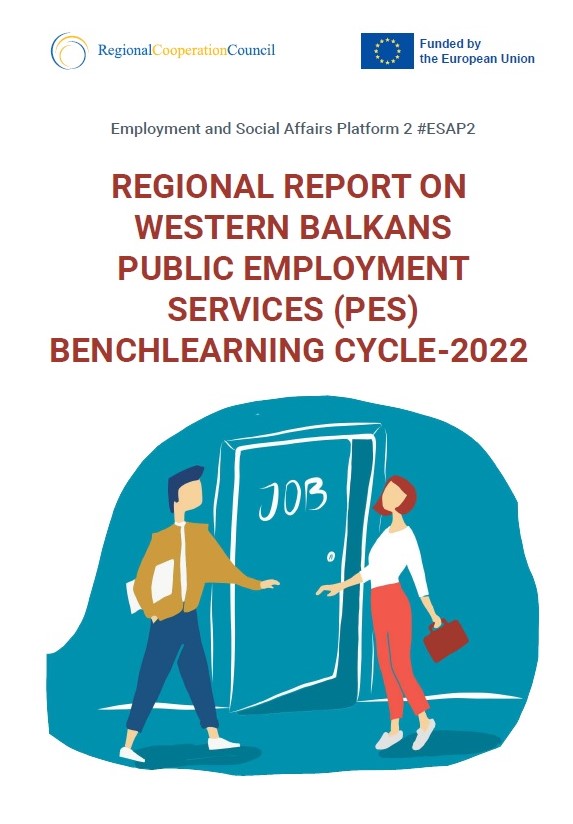
RCC ESAP 2: Regional Report on Western Balkans Public Employment Services (PES) Benchlearning Cycle 2022
26 OCTOBER 2022 | REPORT
This PES Bench-learning Report is based on the results of the 2022 PES Bench-learning cycle in the Western Balkans (WB) facilitated by the he Regional Cooperation Council (RCC) in the framework of the Employment and Social Affairs Platform (ESAP 2), a regional project financed by the European Commission and jointly implemented by the Regional Cooperation Council (RCC) and the International
Labour Organisation (ILO) in Western Balkan economies.
Download: EN
Balkan Barometer Public Opinion 2022
24 JUNE 2022 | SURVEY
Balkan Barometer Public opinion 2022 is 8th edition of RCC's survey of Western Balkan citizens perceptions. The analysis of the results provides a detailed insight into trends and evolution of the attitudes of thousands of
region’s citizens and businesses across socio-economic-environmental topics affecting their everyday lives.
Since the first edition in 2015 the Balkan Barometer became firmly established as a reliable source of regional data widely employed and referenced by media, business, civil society and decision-makers alike.
Balkan Barometer is commissioned by the RCC and financed by the European Union.
Download: EN
Balkan Barometer Business Opinion 2022
24 JUNE 2022 | SURVEY
2022 edition of the Balkan Barometer- the annual survey of Western Balkan business perceptions. It provides insights into trends and evolution of the attitudes of region’s businesses across socio-economic-environmental topics affecting their everyday lives and business. Balkan Barometer Business Opinion survey presented 177 questions to 1203 business owners, managers, or executives in the period mid February to mid-March 2022.
Balkan Barometer is commissioned by the RCC and financed by the European Union.
Download: EN
Balkan Barometer 2022 - INFOGRAPHICS
24 JUNE 2022 | INFORMATION MATERIAL
BALKAN BAROMETER is an annual survey of public opinion and business sentiments in six Western Balkans economies, commissioned by the Regional Cooperation Council (RCC), which examines aspirations and expectations on life and work, prevalent socio-economic and political trends & regional and European integration.
BALKAN BAROMETER’S 2022 infographics booklet features some of the defining thoughts of Western Balkans citizens and businesses on prevailing issues facing the region.
The entire BB survey is available at www.rcc.int/balkanbarometer
Download: EN
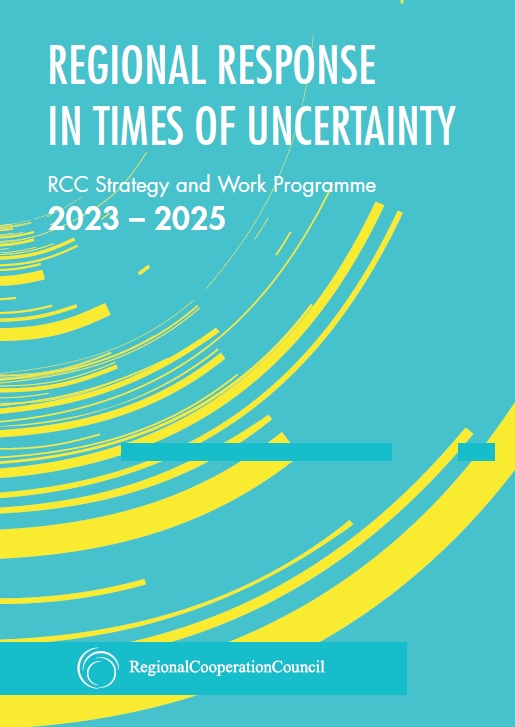
REGIONAL RESPONSE IN TIMES OF UNCERTAINTY: RCC Strategy and Work Programme 2023–2025
09 JUNE 2022 | REPORT
The Strategy and Work Programme 2023-2025 ‘Regional Response in Times of Uncertainty’, of the Regional Cooperation Council (RCC) Secretariat was endorsed at the RCC Annual Meeting, on 9 June 2022 in Thessaloniki, Greece. The overarching goal of SWP 2023-2025 is to promote the prosperity of South East Europe by supporting sustainable and equitable economic growth policies to enhance regional economic integration, green and digital transformation, while reducing the poverty and narrowing the existing social, economic, and environmental divergences with the European Union.
The SWP 2023-2025 serves as the main mid-term plan to prioritise RCC’s activities in line with RCC’s objectives defined by the Statute and the SEE 2030 Strategy, which focuses on the implementation of the UN Sustainable Development Goals through the regional approach.
Download: EN
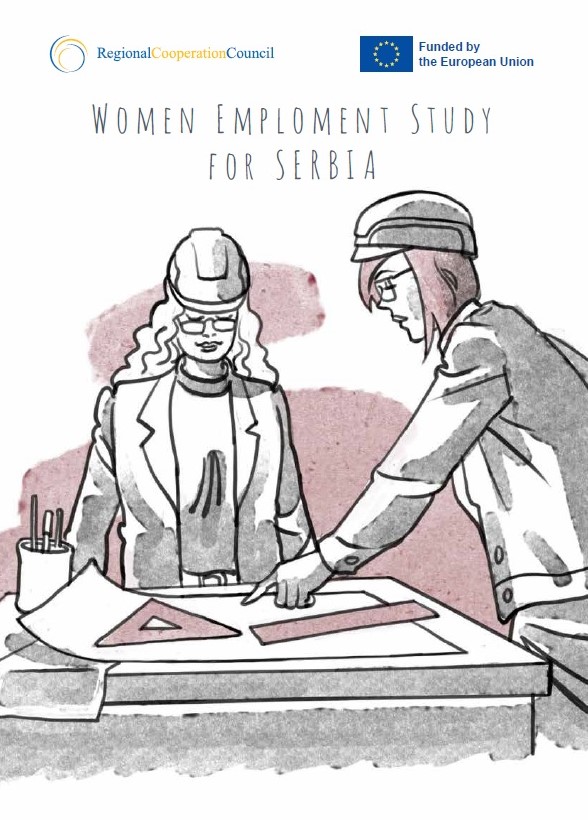
RCC ESAP 2: Women Employment Study for Serbia
01 JUNE 2022 | STUDY
The purpose of the study is to provide a factual state of play of the labour market in Serbia through gender lenses, considering some of the key gender gaps such as the gender gaps in the labour market and the gender care gap and develop recommendations to reduce such gaps.
Download: EN
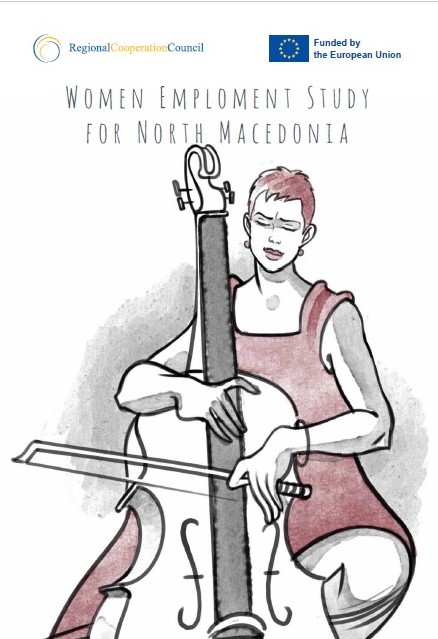
RCC ESAP 2: Women Employment Study for North Macedonia
01 JUNE 2022 | STUDY
In summary, the biggest challenge in the North Macedonian labour market is raising the participation rates of women, a path that can be followed with the adoption of expanded and retargeted active employment measures, gender-specific policies, and through the support of women’s entrepreneurship.
Download: EN
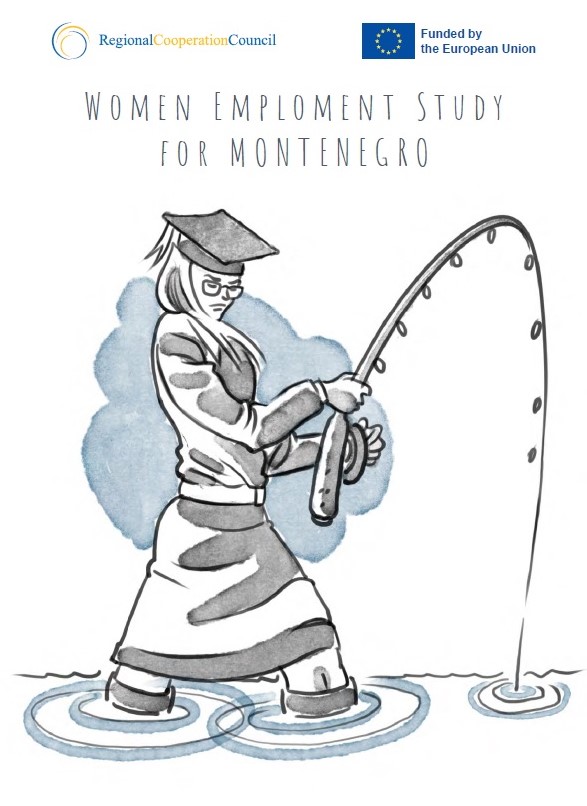
RCC ESAP 2: Women Employment Study for Montenegro
01 JUNE 2022 | STUDY
The purpose of this study is to provide a review of the state of play in the labour market in Montenegro through gender lenses, considering some of the key gender gaps such as the gender gaps in employment, unemployment and pay, uneven gender participation across sectors.
Download: EN
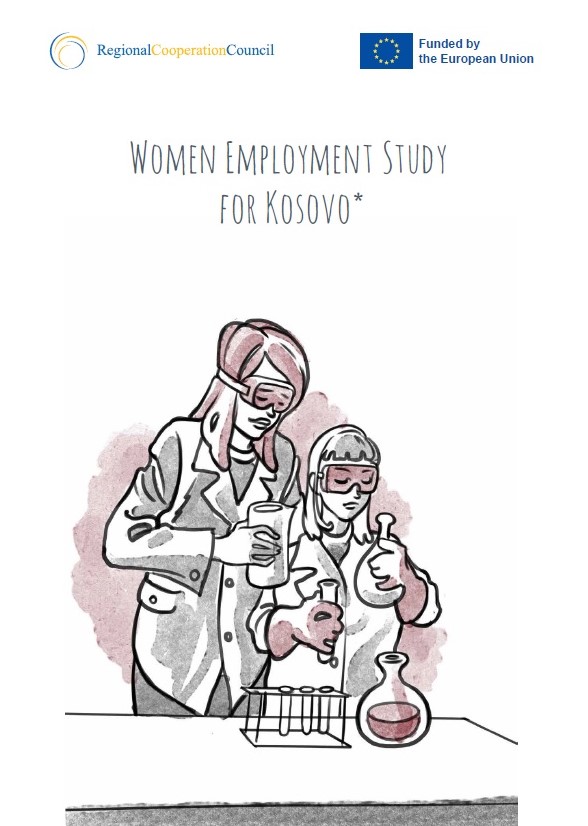
RCC ESAP 2: Women Employment Study for Kosovo*
01 JUNE 2022 | STUDY
The purpose of this study is to provide a gender analysis of the state of play of labour market in Kosovo*. More specifically, this report looks at key gaps between men and women in labour force participation and in employment, analyses employment sector segregation and the gender pay gap, as well as offers an analysis of policies and measures that impact the labour market, from a gender perspective.
Download: EN
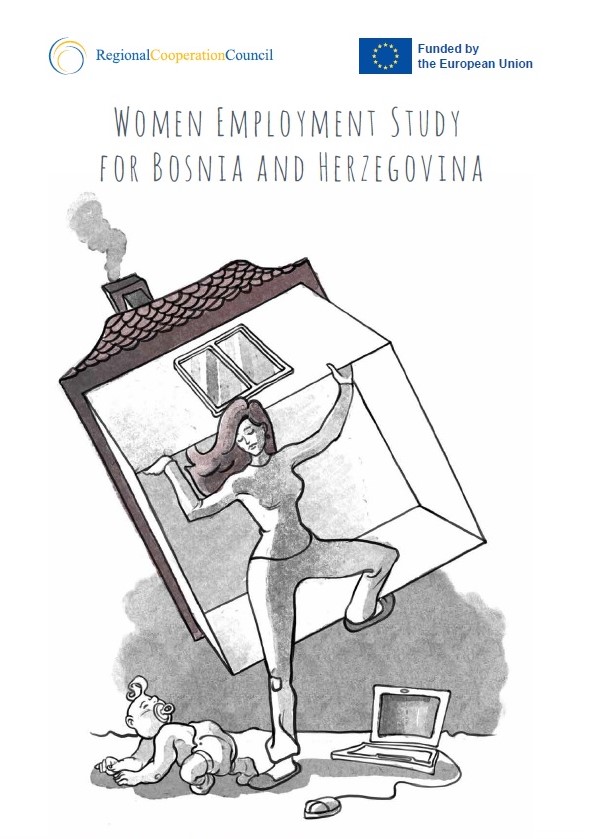
RCC ESAP 2: Women Employment Study for Bosnia and Herzegovina
01 JUNE 2022 | STUDY
This study aims to present the state of play in the labour market in Bosnia and Herzegovina (BiH), with particular emphasis on gender. The study focuses on gender gaps in the labour market.
Download: EN
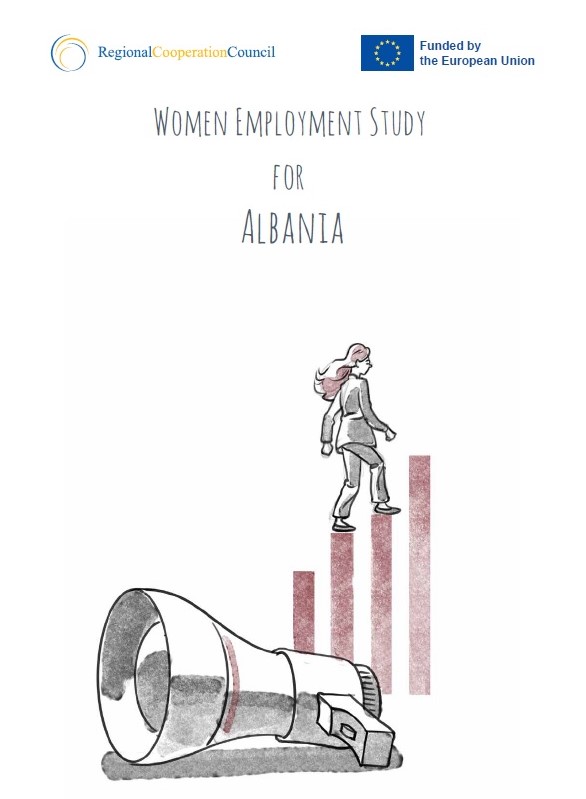
RCC ESAP 2: Women Employment Study for Albania
01 JUNE 2022 | STUDY
Action is needed on horizontal and vertical inclusion of gender indicators and statistics allowing for gender equity evaluations of labour market and entrepreneurship policies, ALMPs and employment promotion programs.
Download: EN
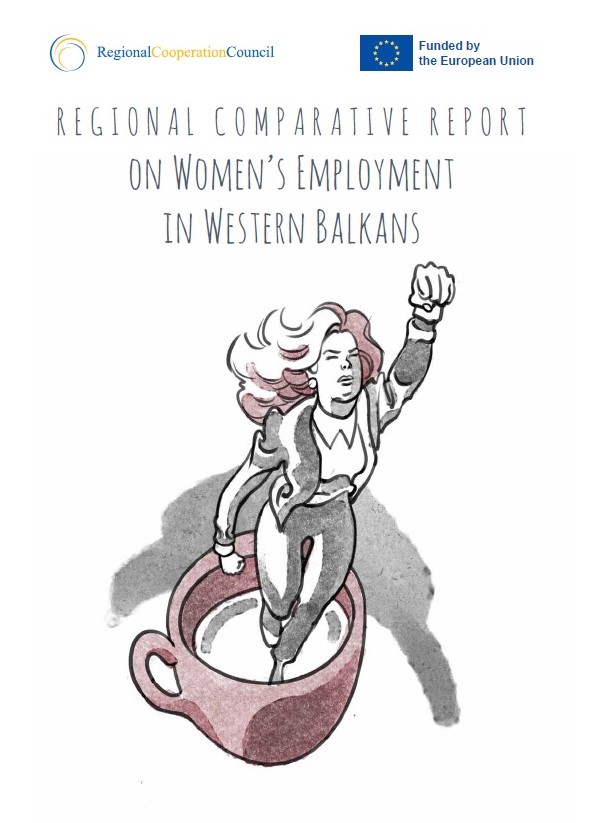
RCC ESAP 2: Regional Comparative Report on Women’s Employment in Western Balkans
01 JUNE 2022 | STUDY
The women’s participation in labour markets of the Western Balkan economies are characterised by low rates of activity, low employment, and high unemployment, especially for youth. The COVID-19 pandemic negatively affected the entire society, but vulnerable groups have been particularly affected.
Download: EN

European Union is Our Future, No Alternative, Interview by RCC Secretary General for Novi Magazin
02 DECEMBER 2021 | INTERVIEW
Secretary General of the Regional Cooperation Council Majlinda Bregu spoke to Serbian Novi Magazin about Western Balkans EU integration, Common Regional Market and Green Agenda for the Western Balkans, region's response to Covid-19 pandemic and much more.
"Weak Western Balkans makes the EU weak too. But a lot is being said each day by both the EU and Western Balkans leaders. The truth is that the enlargement has become a lot more brutal. In times when geostrategic shifts are taking place across the globe, the impasse of Western Balkans EU accession is never a good news. The scale of problems in the Western Balkans is a call to go beyond nudges and patches. Western Balkans is part of Europe, and is of the vital importance in this political realism. The need for Europe is as powerful as it is unsatisfied.", said Bregu, among other things.
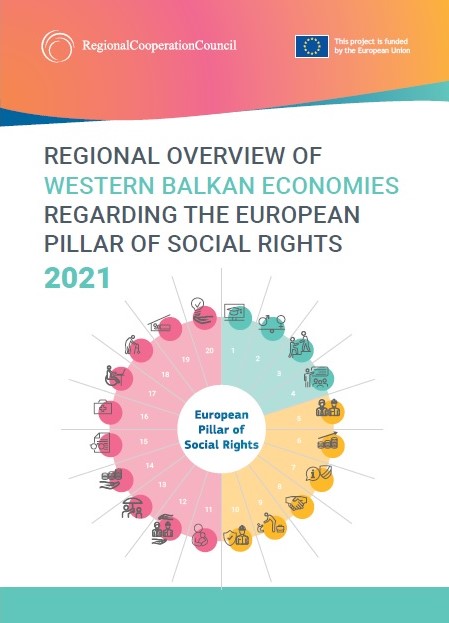
Regional Overview of Western Balkan Economies Regarding the European Pillar of Social Rights 2021
11 OCTOBER 2021 | STUDY
The overview report is written by the European Centre for Social Welfare Policy and Research (European Centre) Research as part of the project “An updated review of the performance of Western Balkan economies regarding the European Pillar of Social Rights” within the framework of the Employment and Social Affairs Platform 2 (ESAP 2) project.
Each Western Balkan economy report provides an update on the progress regarding the principles of the European Pillar of Social Rights (EPSR). The European Commission launched the EPSR in 2017, consisting of a set of 20 social rights that have indicators for monitoring economies’ policy systems.
Download: EN
RCC ESAP 2: Performance of Western Balkan Economies Regarding the European Pillar of Social Rights: 2021 review on Albania
11 OCTOBER 2021 | STUDY
Before the onset of the COVID-19 crisis, Albania has recorded some improvement in the principles of the European Pillar of Social Rights, but its performance was overall relatively weak. The pandemic has massively affected Albania, and in particular the health and social sector. Hence, Albania is
facing the challenges of overcoming pre-existing and new challenges, with most of the social pillar indicators being worse-off than in the pre-crisis period.
Download: EN
RCC ESAP 2: Performance of Western Balkan Economies Regarding the European Pillar of Social Rights: 2021 review on Bosnia and Herzegovina
11 OCTOBER 2021 | STUDY
The COVID-19 crisis has heavily disrupted pre-pandemic trends and developments in Bosnia and Herzegovina (BiH), thus further deteriorating the already weak performance of Bosnia and Herzegovina in majority of areas covered by the report. Modest improvements in the labour market trends recorded during the three-year period preceding the pandemic have been interrupted and, at least temporarily, reversed. Welfare outcomes have been also profoundly impacted by the crisis, with massive job losses, increased poverty, and limited access to public services.
Download: EN
RCC ESAP 2: Performance of Western Balkan Economies Regarding the European Pillar of Social Rights: 2021 review on Kosovo*
11 OCTOBER 2021 | STUDY
Like other economies, Kosovo* has been hit hard by the COVID-19 pandemic. Despite policy support, the economic activity is estimated to have fallen 6 percent in 2020 (IMF, 2021). The fiscal deficit increased to 7.7 percent of GDP, given the large fall in tax revenues and the implementation of
mitigation and recovery measures of 4.2 percent of GDP (IMF 2021). Growth is expected to rebound in 2021 and real activity will most likely reach pre-pandemic levels only in 2022 (IMF, 2021; World Bank, 2021).
Download: EN
RCC ESAP 2: Performance of Western Balkan Economies Regarding the European Pillar of Social Rights: 2021 review on Montenegro
11 OCTOBER 2021 | STUDY
Montenegro’s performance against several indicators of the social scoreboard, designed to monitor the implementation of the European Pillar of Social Rights, remain relatively weak. Despite the fact that between 2017 and 2019 Montenegro achieved a high economic growth rate and a decrease in its unemployment rate, the employment rate remains low and long-term unemployment much is higher than in the EU. The situation got worsened by the COVID-19 pandemic, when the unemployment rate additionally grew, most affected were industries that Montenegro economy relies heavily on – tourism, construction and overall services.
Download: EN
RCC ESAP 2: Performance of Western Balkan Economies Regarding the European Pillar of Social Rights: 2021 review on North Macedonia
11 OCTOBER 2021 | STUDY
As elsewhere, the COVID-19 pandemic created large and unprecedented challenges for the government of North Macedonia in an array of policies and sectors. While it started as a health crisis which required policies and measures to protect the health of the citizens, it soon expanded in an economic crisis, affecting virtually all businesses and workers. The Government of North Macedonia implemented four packages of containment measures against COVID-19 pandemic in 2020 (70 measures in total) and two additional packages in 2021 (with additional 36 measures).
Download: EN
RCC ESAP 2: Performance of Western Balkan Economies Regarding the European Pillar of Social Rights: 2021 review on Serbia
11 OCTOBER 2021 | STUDY
In 2020, the COVID-19 pandemic created enormous challenges for the entire population of Serbia, threatening people’s health, jobs and living standards. Key political, economic, and social institutions found themselves under a prolonged strain to ensure that basic health and social services remain accessible, especially for vulnerable groups. The government’s proactive attitude toward the health crisis and financially impressive near-universal support to businesses and citizens alike certainly significantly cushioned the overall effects of the crisis.
Download: EN
Study on Youth Employment in the Western Balkans
08 JULY 2021 | REPORT
Youth employment is an important policy priority for all governments in the Western Balkans. Along with general economic development, all economies have experienced a positive trend in youth employment creation in recent years. However, youth unemployment remains stubbornly high, while activity and employment rates are far below the levels seen in the EU, with a strong gender bias.
This Study presents a comparative analysis of the region’s youth labour markets.
The Appendices to the Study analyse the youth labour markets and the policy responses in each of the Western Balkan economies.
Download: EN

COMPARATIVE REPORT ON YOUTH EMPLOYMENT IN THE WESTERN BALKANS
08 JULY 2021 | STUDY
This Study presents a comparative analysis of the region’s youth labour markets. The Section 2 analyses the key indicators of the youth labour market that are available from Eurostat, the Observatory on employment in the Western Balkans of the Regional Cooperation Council’s (RCC) Employment and Social Affairs Platform (ESAP 2) project, and Statistical Offices in the Western Balkan economies. Section 3 analyses and summarises the main youth employment measures adopted in each economy in comparative perspective and identifies the main challenges facing youth labour markets in each economy. Section 4 maps the NEET landscape using statistical data and proposes the design of appropriate policies to integrate nonregistered NEETs including tailored outreach mechanisms to identify and assist the most vulnerable NEET groups. Section 5 analyses the capacities of the public employmentservices (PES) in each economy to implement new youth employment measures. Section 6 discusses the key issues around introducing a form of Youth Guarantee in line with the EU ambition to assist in the further development of the region’s youth labour markets and wider economic performance. Section 7 presents brief conclusions.
Download: EN

RCC Secretary General Introductory remarks on the occasion of the launch of Balkan Barometer 2021
24 JUNE 2021 | SPEECH
RCC Secretary General Majlinda Bregu opened the presentation of the 7th edition of RCC's Balkan Barometer.
Balkan Barometer is an annual public and business opinion survey commissioned by the RCC examining Western Balkan citizens and businesses perceptions and expectations towards a variety of thematic areas, such as the EU integration and regional cooperation, digitalisation, green recovery, employment, and for the second year in a row it includes topics concerning a challenging regional COVID-19 induced landscape.
More about the Balkan Barometer can be found here: https://www.rcc.int/balkanbarometer/
Download: EN
Balkan Barometer 2021 - Public Opinion
24 JUNE 2021 | SURVEY
Balkan Barometer 2021 - this is the 7th edition of annual public and business opinion survey commissioned by the RCC which examines Western Balkan citizens and businesses perceptions and expectations towards a variety of thematic areas, such as the EU integration and regional cooperation, digitalisation, green recovery, employment, and for the second year in a row it includes topics concerning a challenging regional COVID-19 induced landscape.
Download: EN
Balkan Barometer 2021 - INFOGRAPHICS
24 JUNE 2021 | INFORMATION MATERIAL
BALKAN BAROMETER is an annual survey of public opinion and business sentiments in six Western Balkans economies, commissioned by the Regional Cooperation Council (RCC), which examines aspirations and expectations on life and work, prevalent socio-economic and political trends & regional and European integration.
BALKAN BAROMETER’S 2021 infographics booklet features some of the defining thoughts of Western Balkans citizens and businesses on prevailing issues facing the region.
The entire BB survey is available at www.rcc.int/balkanbarometer
Download: EN
Balkan Barometer Business Opinion
23 JUNE 2021 | SURVEY
Balkan Barometer 2021 - this is the 7th edition of annual public and business opinion survey commissioned by the RCC which examines Western Balkan citizens and businesses perceptions and expectations towards a variety of thematic areas, such as the EU integration and regional cooperation, digitalisation, green recovery, employment, and for the second year in a row it includes topics concerning a challenging regional COVID-19 induced landscape.
Download: EN
RCC ESAP 2: DATA COLLECTION, SHARING AND ANALYSIS TO TACKLE UNDECLARED WORK: A TOOLKIT
18 JUNE 2021 | INFORMATION MATERIAL
Collecting, sharing and analysing data can improve enforcement authority performance not only in detecting undeclared work but also preventing non-compliance. The aim of this toolkit is to support enforcement authorities in the Western Balkans to improve their knowledge and awareness of how to develop efficient databases to detect, prevent and predict undeclared work. The objectives of this toolkit are (i) to discuss the challenges faced around data collection, sharing and analysis and (ii) to offer tips on how data collection, sharing and analysis could be improved, not least by reporting good practices.
Download: EN
Annual Report of the Secretary General of the Regional Cooperation Council 2020-2021
16 JUNE 2021 | REPORT
This Annual Report of the Secretary General of the Regional Cooperation Council (RCC) covers the period April 2020 – April 2021. It outlines main RCC activities and achievements in the past year. It also lays out the overall background and crucial developments impacting and shaping the activities of the RCC and the region of South East Europe in the reporting period.
Annual Report of the Secretary General of the Regional Cooperation Council 2020-2021 has been adopted at the SEECP Summit held in Antalya on 17 June 2021. The document was adopted with reservation of Kosovo*.
*This designation is without prejudice to positions on status, and is in line with UNSCR 1244/1999 and the ICJ Opinion on the Kosovo declaration of independence.
Download: EN
South East Europe Strategy 2030
16 JUNE 2021 | REPORT
The SEE 2030 Strategy is a joint call for action by all 13 SEE economies. The Strategy seeks to promote and advance through regional cooperation the implementation of UN Sustainable Development Goals within the SEE region across the three dimensions of sustainable development: Prosperity; People; and Peace and Partnerships.
Download: EN
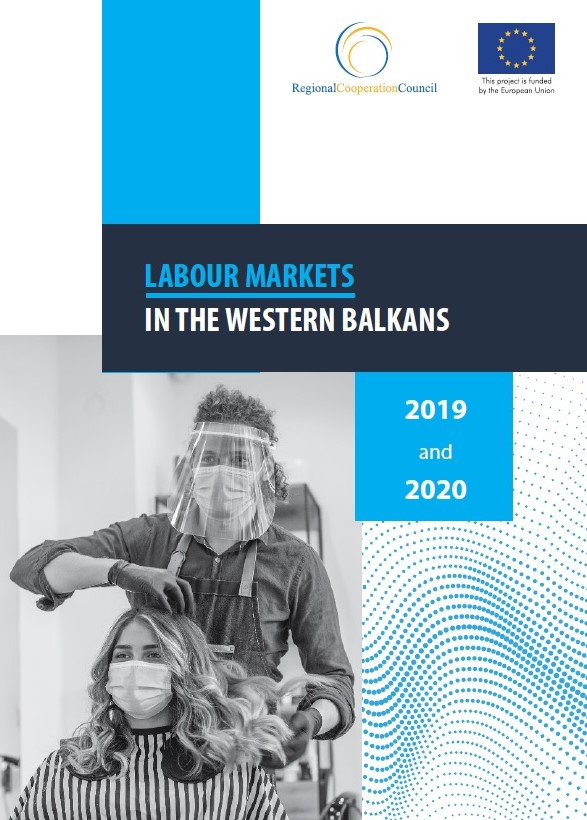
Labour Markets in the Western Balkans: 2019 and 2020
11 JUNE 2021 | STUDY
This Study analyses the situation in each of the six Western Balkan economies’ labour markets in 2019 and during the COVID-19 pandemic in 2020. It considers the factors that affect the region’s labour markets, the measures undertaken by governments to mitigate the effects of the COVID-19 pandemic, and how these have affected labour market outcomes. It includes an analysis of the structure of the labour force, including employment and unemployment in general and that of particular groups, including youth, low-skilled workers, and women as well as the long-term unemployed and the informal economy. Additionally, factors related to economic and sectoral developments that have affected job losses and opportunities for job creation are considered.
Download: EN
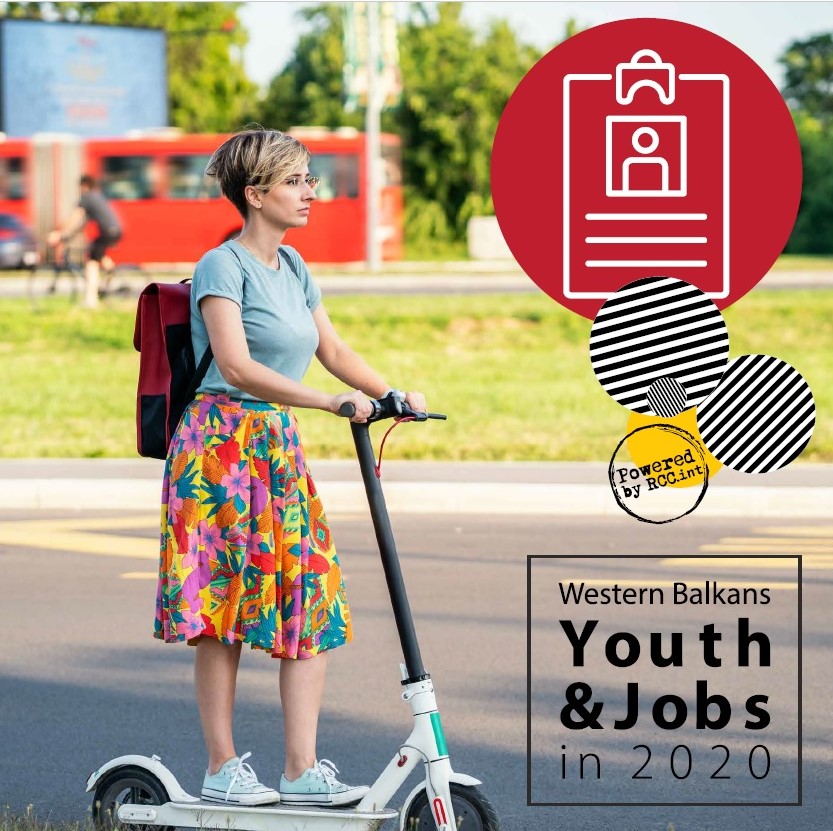
Brochure: Youth & Jobs in the Western Balkans
31 MAY 2021 | INFORMATION MATERIAL
Western Balkans - Youth & Jobs brochure captures key findings of the RCC's ESAP 2 Study on Youth Employment in the Western Balkans, portraying the position of the young people in the labour market in the six economies of the region.
Download: EN
RCC ESAP 2: STUDY ON YOUTH EMPLOYMENT IN ALBANIA
31 MAY 2021 | STUDY
This Annex to Study on Youth Employment in the Western Balkans outlines the nature and challenges of the youth labour market in Albania, among which the lack of job opportunities in the private sector especially for highly educated young people, the consequent migration of young people and subsequent difficulties in integrating returning migrants into the labour market, weaknesses in the vocational training system at secondary school level, a high prevalence of self-employment and informality, and a high incidence of young people neitherin employment, nor in education or training (NEETs) have been identified as key factors creating difficulties in the youth labour market.
Download: EN

RCC ESAP 2: STUDY ON YOUTH EMPLOYMENT IN BOSNIA AND HERZEGOVINA
31 MAY 2021 | STUDY
This Annex of the Study on Youth Employment in the Western Balkans outlines the nature and challenges of the youth labour market in Bosnia and Herzegovina, among which the fragmentation of the youth labour market and employment policy, pervasive skill mismatch, limited availability of part-time work opportunities for women, employment policies insufficiently targeted on youth and a limited provision of youth counselling services have been identified as key factors holding back integration of young people into the labour market. The youth labour market in Bosnia and Herzegovina is characterised by high level of youth unemployment, large gender gaps in labour market participation and employment, especially for the less well educated youth, and a high share of temporary jobs creating a precarious situation for young people.
Download: EN

RCC ESAP 2: STUDY ON YOUTH EMPLOYMENT IN KOSOVO*
31 MAY 2021 | STUDY
This Annex of the Study on Youth Employment in the Western Balkans outlines the nature and challenges of the youth labour market in Kosovo*, among which the lack of job opportunities, weaknesses in the education system, widespread skill mismatches and skill gaps,lack of work experience of vocational education and training (VET) school and university graduates and lack of information about job vacancies have been identified as key factors holding back the integration of young people into the labour market.
Download: EN

RCC ESAP 2: STUDY ON YOUTH EMPLOYMENT IN MONTENEGRO
31 MAY 2021 | STUDY
This Annex to the Study on Youth Employment in the Western Balkans outlines the nature and challenges of the youth labour market in Montenegro, among which lack of suitable jobs in the private sector, the lack of an entrepreneurial culture, the lack of appropriate skills held by young people, the preference for secure public sector jobs, and the perceptions of unfair recruitment practices have been identified as key factors holding back the integration of young people into the labour market.
Download: EN

RCC ESAP 2: STUDY ON YOUTH EMPLOYMENT IN NORTH MACEDONIA
31 MAY 2021 | STUDY
This Annex to the Study on Youth Employment in the Western Balkans outlines the nature and challenges of the youth labour market in North Macedonia. Although the youth unemployment rate has declined in recent years it remains elevated and many unemployed young people face long term unemployment, reflecting substantial skills mismatches. The youth labour market is also characterised by large gender gaps in labour market participation and employment, while the participation and employment rates are especially low for young people with a low level of education.
Download: EN

RCC ESAP 2: STUDY ON YOUTH EMPLOYMENT IN SERBIA
31 MAY 2021 | STUDY
This Annex to the Study on Youth Employment in the Western Balkan outlines the nature and challenges of the youth labour market in Serbia, among which the lack of job opportunities, a lack of support for youth entrepreneurship, the prevalence of precarious employment of youth, poor educational provision and lack of infrastructure and teaching materials at secondary vocational education and training (VET) schools (attended by three quarters of upper secondary school pupils) leading to a mismatch of skills with labour market needs, and a revolving door of internships and a difficult transition from higher education to work of university graduates as well as the prevalence of informal channels of finding a job have been identified as key factors holding back the integration of young people into the labour market.
Download: EN
RCC ESAP 2 presents the Study on Youth Employment in the Western Balkans: Key findings and recommendations
31 MAY 2021 | INFORMATION MATERIAL
The presentation covers the following topics: Youth labour markets; Key challenges; Youth employment policies in place; NEET policies and PES capacities; and Youth Guarantee(s)
Download: EN
RCC ESAP 2: IMPROVING SOCIAL PARTNER INVOLVEMENT IN TACKLING UNDECLARED WORK: A TOOLKIT
31 MAY 2021 | INFORMATION MATERIAL
The aim of this toolkit is two-fold. Firstly, it sets out the steps that need to be taken by social partners and enforcement authorities in the Western Balkans to initiate, develop and manage cooperation with each other and build effective partnerships, along with examples of good practices of collaboration in the Western Balkans, European Union and beyond that are potentially transferable to all Western Balkan economies. Secondly, the aim is to set out the full range of policy initiatives that social partners can pursue to tackle undeclared work either on their own or in collaboration with enforcement authorities. Again, interesting policy initiatives pursued by social partners across the Western Balkans, European Union and beyond will be highlighted that are potentially transferable to all Western Balkan economies.
Download: EN
RCC ESAP 2: Tackling Undeclared Work in the Western Balkans: Improving the Range and Effectiveness of Sanction Tools
05 MAY 2021 | REPORT
The objective of this report is to enable Western Balkan enforcement authorities to share and deepen their understanding of:
• the effectiveness of using sanctions to tackle undeclared work, and
• the range of sanction tools available.
Most research finds that increasing the penalties does not decrease the likelihood of participation in undeclared work.
Download: EN
RCC ESAP 2: Improving the Involvement of Social Partners in Tackling Undeclared work: A Learning Resource
05 MAY 2021 | REPORT
On 19th April 2021, the Western Balkan Network Tackling Undeclared Work held an online seminar that brought together representatives from enforcement authorities and social partners. The intention was to discuss and share understanding of the major challenges they face in pursuing greater cooperation and provide tips for other Western Balkan economies on how these challenges might be addressed. It was also an opportunity to explore the scope for greater cooperation and to share learning on the type of initiatives that social partners can pursue to protect legitimate businesses and workers by transforming undeclared work into declared work.
The aim of this learning resource is to summarise the discussion at the seminar. To do so, section 2 reports the discussion on the scope for greater cooperation between enforcement authorities and social partners, section 3 reports the discussion on the types of initiatives in which social partners could become more involved and section 4 the next steps that can be taken.
Download: EN

COVID-19 and the World of Decent Work
29 APRIL 2021 | INTERVIEW
Article on the occasion of 1 May, Labour Day
2021 edition of the International Labour Day: COVID-19 and the World of Decent Work
"Around a quarter of youth in the Western Balkans are NEETs – neither in employment, education or training (2019 data). Moreover, out of the total registered unemployed at the end of February 2021, 173,031 are young people, under 24 years, which is more than 12% of all registered unemployed."
By Majlinda Bregu, Secretary General of the Regional Cooperation Council (RCC)
Economic Benefits of Gender Equality and Women Empowerment in the Western Balkans Six
13 APRIL 2021 | STUDY
The purpose of this study is to shed light on the labour market situation of women in the WB6 economies, assess the economic benefits of women empowerment and provide recommendations for the way forward. Using gender disaggregated data, a comprehensive analysis of the current situation of gender equality and women empowerment in the WB was performed. The economic benefits of gender equality measures were estimated. A Women Empowerment Index (WEI) was developed to measure the economic empowerment of women in the WB6. The study also contains stocktaking and assessment of key policy areas and measures to reduce gender inequality and promote economic empowerment of women in the WB region.
Download: EN
Report on the Activities of the Regional Cooperation Council Secretariat for the period 1 October 2020 – 1 March 2021
29 MARCH 2021 | REPORT
The Report on the activities of the Regional Cooperation Council (RCC) Secretariat is submitted by the RCC Secretary General to the RCC Board in line with Article 15 of the Statute of the RCC. It covers the period between 1 October 2020 – 1 March 2021.
Download: EN
RCC ESAP 2: EVALUATING THE INVOLVEMENT OF SOCIAL PARTNERS IN TACKLING UNDECLARED WORK IN THE WESTERN BALKANS
10 MARCH 2021 | STUDY
This study reports the results of a survey of social partners undertaken in October 2020 to assess: their adoption of the objective of transforming undeclared work into declared work; the current level of involvement of social partners with government in relation to tackling undeclared work, and current range of policy initiatives social partners use to tackle undeclared work.
Download: EN

Recovering from COVID-19: How and With Whom?
29 JANUARY 2021 | INTERVIEW
Recovering from COVID-19: How and With Whom?, Article by Majlinda Bregu, Secretary General of the Regional Cooperation Council (RCC)
OBSERVING the Western Balkans through Employment Observatory
"Regional Cooperation Council (RCC), our Employment and Social Affairs Platform 2 (ESAP 2) project to be more specific, prepared Observatory on employment in the Western Balkans.
Yes. Observatory is not something you never heard of before. However, this is the first one of its kind. An online platform that compiles and presents labour market data gathered from official sources in each of the six Western Balkan economies."
RCC ESAP 2: RETHINKING THE FUTURE OBJECTIVES, ROLES AND COMPETENCIES OF INSPECTORATES AND INSPECTORS
07 DECEMBER 2020 | REPORT
Rethinking the future objectives, roles and competencies of inspectorates and inspectors report, by Colin C Williams, sets out the key issues involved in developing modern LIs and TAs in terms of capacity building, skills and competencies. The intention is to stimulate and structure thinking about the issues involved and the various options available, in terms of capacity building and developing skills and competencies, when modernising labour inspectorates and tax authorities.
Download: EN
RCC ESAP 2: A HANDBOOK OF PREVENTATIVE APPROACHES TOWARDS UNDECLARED WORK
17 NOVEMBER 2020 |
The aim of this handbook is to provide a compendium of the range of preventative approaches for tackling undeclared work available to economies.
Download: EN
Regional Overview of Western Balkan Economies Regarding the European Pillar of Social Rights
02 OCTOBER 2020 | REPORT
This comparative report draws on six individual economy reviews of the performance of each Western Balkan economy regarding the European Pillar of Social Rights. The Pillar encompasses 20 principles that serve as a reference for better working and living conditions across the areas of equal opportunities and access to the labour market, fair working conditions, and social protection and inclusion.
The Report was prepared under the overall guidance of the Regional Cooperation Council (RCC) in the framework of the Employment and Social Affairs Platform (ESAP 2) regional project, funded by the EU.
Download: EN
RCC ESAP 2: Performance of Western Balkan economies regarding the European Pillar of Social Rights: Updated review on Bosnia & Herzegovina
31 AUGUST 2020 | REPORT
The initial report was written by Amar Numanović and Nikolina Obradović in August 2019.
This report was updated in 2020 by Amar Numanović from European Centre for Social Welfare Policy and Research in the framework of the Regional Cooperation Council's (RCC) Employment and Social Affairs Platform 2 (ESAP2) project.
Download: EN
RCC ESAP 2: Performance of Western Balkan economies regarding the European Pillar of Social Rights: Updated review on Albania
31 AUGUST 2020 | REPORT
The original report was written by Esmeralda Shehaj in collaboration with ICF and the European Centre for Social Welfare Policy and Research in April 2019. The updated report was written by Esmeralda Shehaj in 2020, in the framework of the Regional Cooperation Council's (RCC) Employment and Social Affairs Platform 2 (ESAP 2) project.
Download: EN
RCC ESAP 2: Performance of Western Balkan economies regarding the European Pillar of Social Rights: Updated review on Kosovo*
31 AUGUST 2020 | REPORT
The original report was written by Ardiana Gashi & Amir Haxhikadrija in April 2019. This updated report was written by Ardiana Gashi in 2020, in the framework of the Regional Cooperation Council's (RCC) Employment and Social Affairs Platform 2 (ESAP 2) project
Download: EN
RCC ESAP 2: Performance of Western Balkan economies regarding the European Pillar of Social Rights: Updated review on Montenegro
31 AUGUST 2020 | REPORT
The original report was written by Vojin Golubovic in collaboration with ICF and the European Centre for Social Welfare Policy and Research in April 2019. This report was updated by Olivera Komar in 2020, in the framework of the Regional Cooperation Council's (RCC) Employment and Social Affairs Platform 2 (ESAP2) project.
Download: EN
RCC ESAP 2: Performance of Western Balkan economies regarding the European Pillar of Social Rights: Updated review on North Macedonia
31 AUGUST 2020 | REPORT
The original report was written by Nikica Mojsoska-Blazevski in collaboration with the European Centre for Social Welfare Policy and Research in April 2019. The updated report was written by Nikica Mojsoska-Blazevski in 2020, in the framework of the Regional Cooperation Council's (RCC) Employment and Social Affairs Platform 2 (ESAP 2) project.
Download: EN
RCC ESAP 2: Performance of Western Balkan economies regarding the European Pillar of Social Rights: Updated review on Serbia
31 AUGUST 2020 | REPORT
The original report was written by Mihail Arandarenko in collaboration with ICF and the European Centre for Social Welfare Policy and Research in 2019. The updated report was written by Mihail Arandarenko in 2020, in the framework of the Regional Cooperation Council's (RCC) Employment and Social Affairs Platform 2 (ESAP 2) project.
Download: EN

Majlinda Bregu, Secretary General of the RCC on 1st edition of Balkathon and future plans in an interview for Albanian Business Magazine
10 AUGUST 2020 | INTERVIEW
"Encouraging innovative ideas, promoting digital solutions and creating room for the introduction of new ideas are the daily efforts on the part of RCC, its mindset not only in terms of thinking but also in terms of acting. It goes without saying that Covid-19 did provide an incentive, for instance when realizing how much more the private sector was using digital solutions. The Regional Cooperation Council (RCC) found its inspiration for Balkathon in the efforts made by EU Member States and Western Balkan economies to adjust their way of life in light of the new reality, starting off with the printing of 3D masks, the creation of online teaching and learning platforms, the creation of applications that facilitate online shopping, etc."
RCC ESAP 2: DEVELOPING A HOLISTIC INTEGRATED STRATEGIC APPROACH TOWARDS UNDECLARED WORK: A TOOLKIT
17 JULY 2020 | REPORT
In many economies, a fragmented and uncoordinated approach exists across the multifarious government bodies responsible for tackling undeclared work and limited integration of social partners, as well as an incomplete range of policy measures used. The aim of this toolkit is to set out the steps required to develop a holistic integrated strategic approach towards undeclared work.
Download: EN
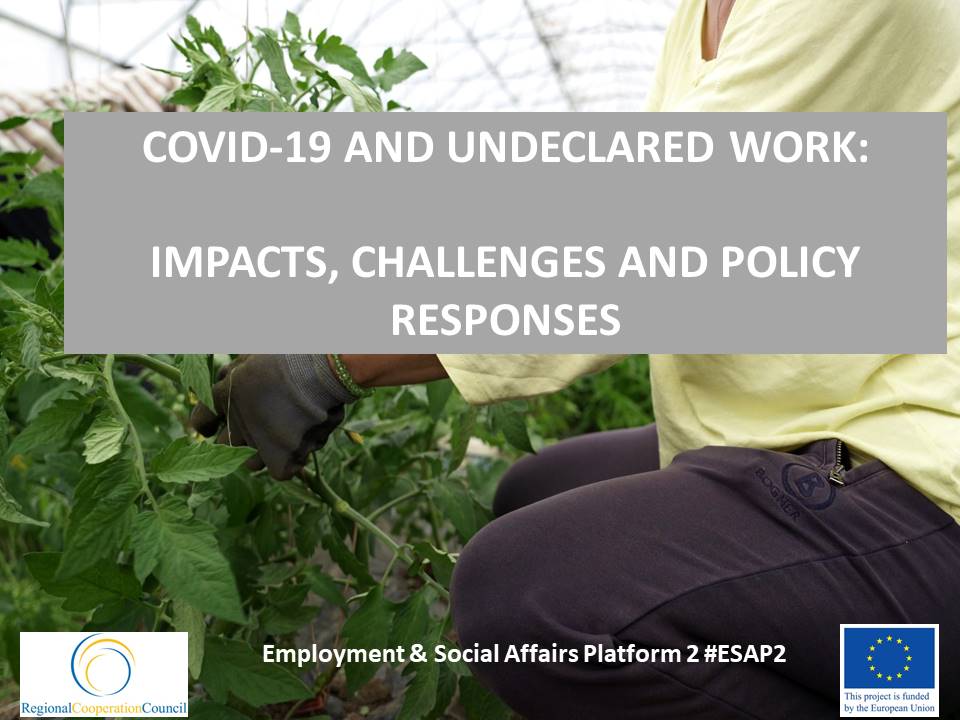
RCC ESAP 2: COVID-19 AND UNDECLARED WORK in the Western Balkans: IMPACTS, CHALLENGES AND POLICY RESPONSES
01 JULY 2020 | STUDY
Report on the Western Balkan Network tackling undeclared work: COVID-19 AND UNDECLARED WORK: IMPACTS, CHALLENGES AND POLICY RESPONSES
Author: Colin C Williams
In early January 2020, a new strain of coronavirus (SARS-CoV-2) producing a respiratory disease (COVID-19) began spreading across the globe. On the 30th January 2020, the World Health Organisation declared a global health emergency and on 11th March a pandemic was confirmed. The impact on businesses and workers, as well as economies, has been profound. By April 2020, the closure of businesses to restrict movement and the spread of the virus had affected 81% of the global workforce (ILO, 2020a). This led to the cessation of not only declared work but also undeclared work.
Download: EN
Annual Report of the Secretary General of the Regional Cooperation Council 2019-2020
25 JUNE 2020 | REPORT
This Annual Report of the Secretary General of the Regional Cooperation Council (RCC) covers the period April 2019 – April 2020. It outlines main RCC activities and achievements in the past year. It also lays out the overall background and crucial developments impacting and shaping the activities of the RCC and the region of South East Europe in the reporting period.
Download: EN
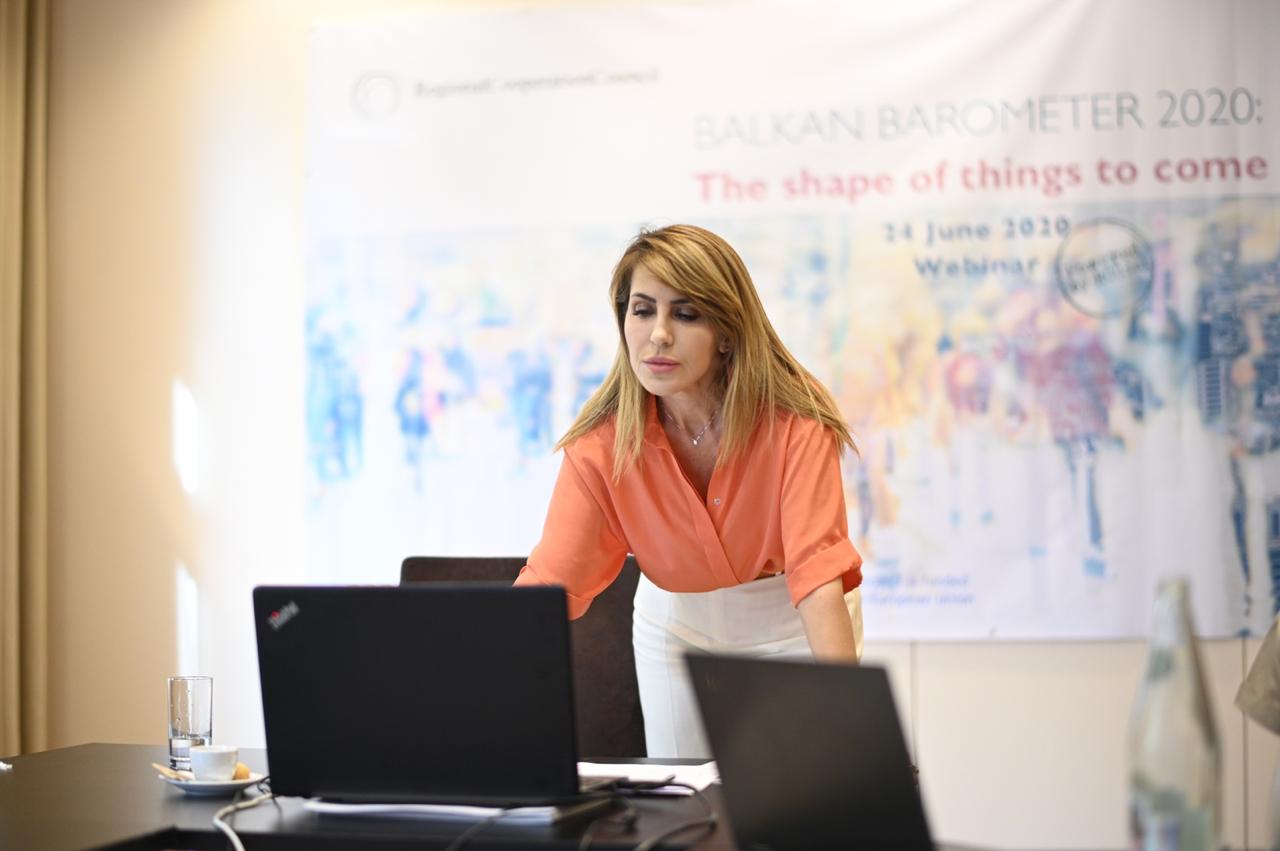
RCC SG speech at the presentation of Balkan Barometer 2020 on 24 June 2020
24 JUNE 2020 | SPEECH
Introductory remarks by the Secretary General of the Regional Cooperation Council Majlinda Bregu on the ocassion of Balkan Barometer 2020 launch held in a form of webinar on 24 June 2020
Download: EN
BALKAN BAROMETER 2020: PUBLIC OPINION SURVEY
24 JUNE 2020 | SURVEY
Balkan Barometer 2020 - the 6th edition of the annual public opinion survey commissioned by the Regional Cooperation Council to gather and interpret data spanning a number of thematic areas and topics. The Barometer examines the region’s perceptions of today, and its expectations for tomorrow, giving voice to the SEE’s business community as well as its citizens at large.
The Balkan Barometer: Public Opinion Survey carries perceptions of the citizens at large, examining their views of the current situation and future expectations.
Download: EN
BALKAN BAROMETER 2020: BUSINESS OPINION SURVEY
24 JUNE 2020 | SURVEY
Balkan Barometer 2020 - the 6th edition of the RCC of the annual business opinion survey commissioned by the Regional Cooperation Council to gather and interpret data spanning a number of thematic areas and topics. The Barometer examines both the region’s perceptions of today, and its expectations for tomorrow, giving voice to the SEE’s business community as well as its citizens at large.
Download: EN
Balkan Barometer 2020: Covid-19 impact assessment
24 JUNE 2020 | SURVEY
Following the annual issue of the Balkan Barometer survey, the Regional Cooperation Council (RCC) initiated additional analysis to observe more closely sentiments and perceptions of the general public and the business community in the context of recent developments deriving from COVID-19. In this respect, RCC engaged in data collection and data processing as a basis for snap-shot analysis of the attitudes, experiences and perceptions on the recent developments in six economies.
Download: EN
BALKAN BAROMETER 2020 - INFOGRAPHICS
22 JUNE 2020 | INFORMATION MATERIAL
BALKAN BAROMETER is an annual survey of public opinion and business sentiments in six Western Balkans economies, commissioned by the Regional Cooperation Council (RCC), which examines aspirations and expectations on life and work, prevalent socio-economic and political trends & regional and European integration.
BALKAN BAROMETER’S 2020 infographics booklet features some of the defining thoughts of Western Balkans citizens and businesses on prevailing issues facing the region.
The entire BB survey is available at www.rcc.int/balkanbarometer
Download: EN

Viral slowdown, Article by Majlinda Bregu, Secretary General of the Regional Cooperation Council (RCC)
19 JUNE 2020 | INTERVIEW
Article by the RCC SG on the effects of coronavirus on employment in the Western Balkans.
"According to ILO estimates, in the second quarter of 2020 the Western Balkans will lose 11.6% of hours worked due to the COVID-19 pandemic. This is equivalent to more than 800,000 employment losses and could almost entirely wipe out the gains in employment the region has accumulated since 2012."
"While ensuring the health of the population is of utmost priority, economic measures need to be implemented hand in hand in order to preserve employment through subsidies and financial support or to compensate for the loss of jobs or economic activity.
Any economic and employment support scheme in the Western Balkans should also be accompanied by incentives to tackle some of the existing labour market challenges, such as for instance supporting the transition from undeclared into declared work as well as reskilling and upskilling the workforce in order to prepare them better for a continuously evolving labour market."
RCC Secretary General for Radio Free Europe (RFE)
05 MAY 2020 | INTERVIEW
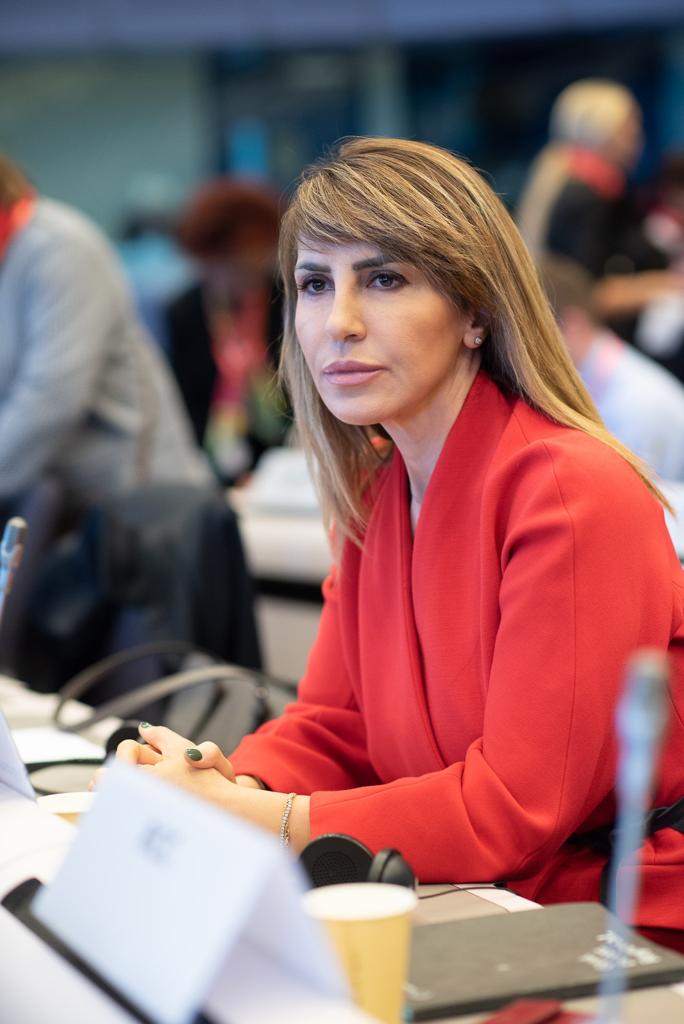
“Implementation of initiatives to strengthen cooperation amongst the [Western] Balkans Six economies would create conditions for better life of our citizens. What might save us from pains is for the political leaders and experts to say, because coronavirus pandemic is an abnormal situation that comes with abnormal risks. Cooperation is vital and I believe we all got the idea that solo play will bring us nowhere,” said, among other things, RCC Secretary General Majlinda Bregu in Radio Free Europe’s (RFE) article dubbed “Economic cooperation in Western Balkans: Solo play will bring us nowhere” analyzing the effects COVID-19 pandemic will have on the economy of Western Balkans.
The full article including the original answers to RFE questions provided by the RCC SG is available in the document.
Download: EN

1st of May 2020: Not the Labour Day as We Know It, Article by Nand Shani, Team Leader of ESAP 2
30 APRIL 2020 | INTERVIEW
Article on the occasion of 1 May, Labour Day
1st of May 2020: Not the Labour Day as We Know It
Coronavirus in the Western Balkans: Testing immunity of the world of work
By Nand Shani, Team Leader of Employment and Social Affairs Platform Project (ESAP 2), implemented jointly by the Regional Cooperation Council (RCC) and the International Labour Organisation (ILO), funded by the EU
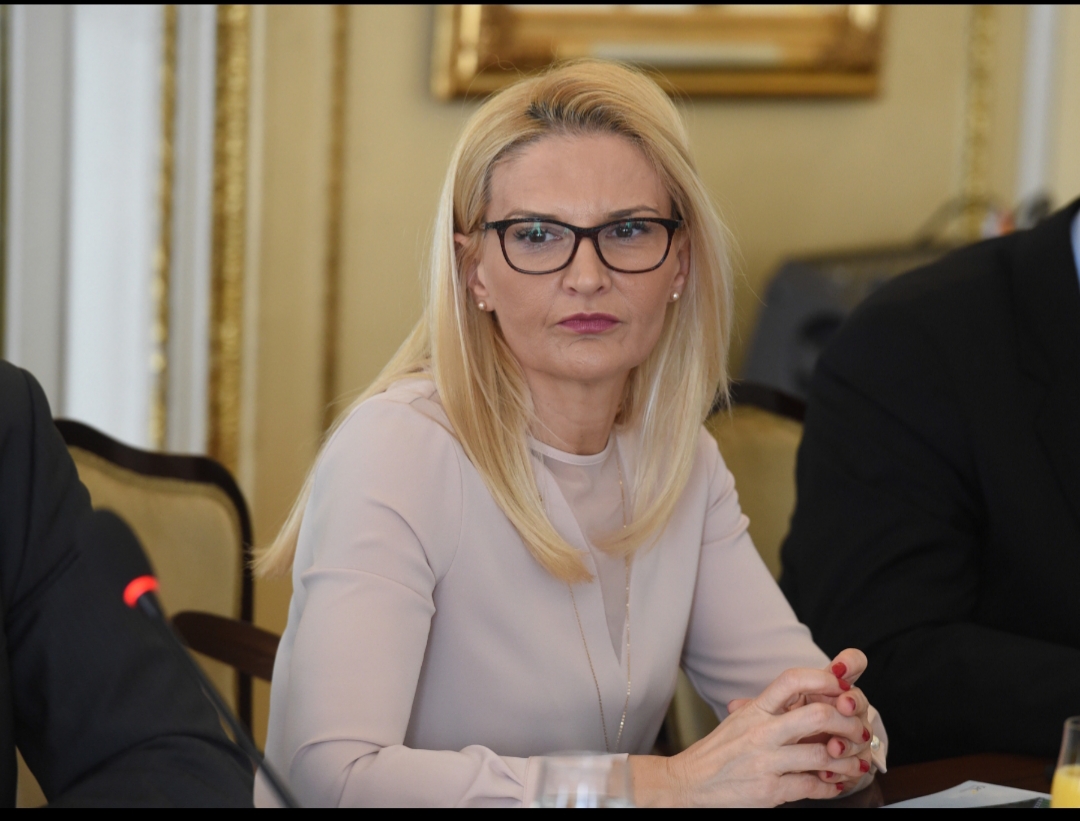
Tanja Miscevic, RCC's Deputy Secretary General for the European Western Balkans (EWB)
29 APRIL 2020 | INTERVIEW
Deputy Secretary General of the Regional Cooperation Council (RCC) spoke to European Western Balkans (EWB) about the priorities of regional cooperation at the time of the pandemic, economic recovery plans and cooperation between RCC and the governments of the region, as well as the support the EU has provided for the Western Balkans.
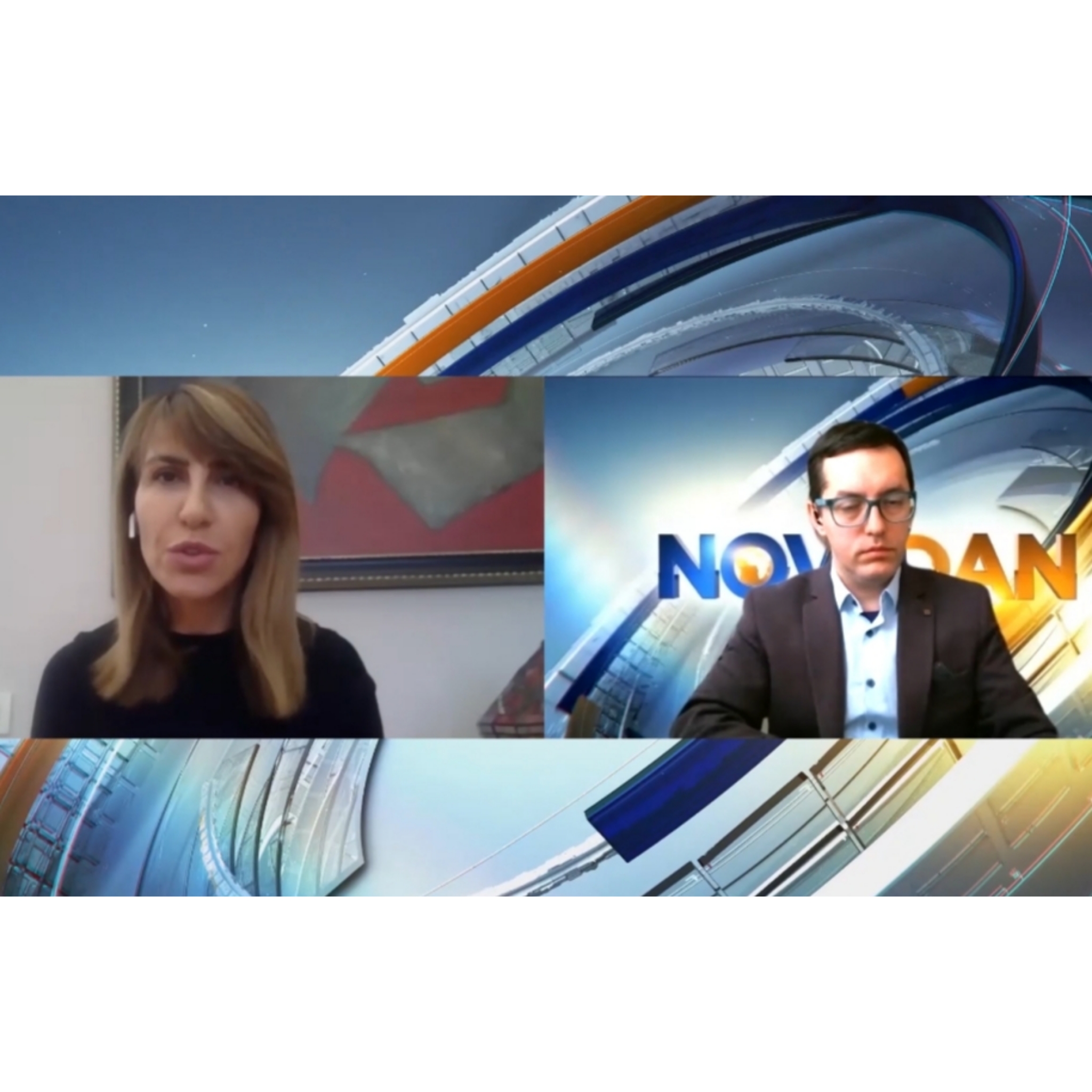
Majlinda Bregu, RCC SG's interview for N1 about the Western Balkans during & after COVID-19 pandemic
26 APRIL 2020 | VIDEO INTERVIEW
Majlinda Bregu, Secretary General of the Regional Cooperation Council (RCC) talks to N1 TV in an online interview about life in the Western Balkans during the corona virus pandemic, its effects on the tourism sector, Green Corridors and the EU integration of the region
REPORT ON THE ACTIVITIES OF THE REGIONAL COOPERATION COUNCIL SECRETARIAT
12 MARCH 2020 | REPORT
The Report on the activities of the Regional Cooperation Council (RCC) Secretariat is submitted by the RCC Secretary General to the RCC Board in line with Article 15 of the Statute of the RCC. It covers the period between 15 October 2019 – 1 March 2020.
Download: EN
ESAP PHASE 2: Transitioning into formality and decent work in the Western Balkans
28 JANUARY 2020 |
Informal employment and lack of social dialogue take centre stage among the key issues that need significant improvements
to meet the EU accession criteria. Against this background, Employment and Social Affairs Platform (ESAP 2) – a project
implemented by the Regional Cooperation Council (RCC) and International Labour Organisation (ILO), enters its second
phase (ESAP 2), consolidating the results achieved under its 1st phase and expanding to cover additional employment and
social policy topics of high relevance for Western Balkans.
Download: EN
ESAP 1 - Key achievements
28 JANUARY 2020 |
The Employment and Social Affairs Platform (ESAP), funded by the EU and implemented jointly by the Regional Cooperation Council (RCC) and International Labour Organisation (ILO) in period from 2016 to 2019, supported the Western Balkan (WB) Six economies in labour market, employment and social policy reforms aimed at increasing employment opportunities for all across the region.
Under ESAP, the ILO has supported labour inspectorates, agencies for peaceful settlement of labour disputes, and ESCs with the aim to strengthen social dialogue, modernise labour inspection functions taking into consideration international labour standards and enhance alternative resolution of labour disputes.
The RCC, under ESAP, has enhanced institutional capacities of Public Employment Services (PES) and Ministries of Labour (MoL) for employment and labour market policy reviews through peer reviews; improved PES-to-PES dialogue by introducing benchlearning exercise for the first time ever in the region, based on the EU PES model; supported development of a holistic approach to tackling undeclared work in the region; and addressed partners’ small-scale demands in furthering their national employment and social reform agenda.
Download: EN

Article by Majlinda Bregu, Secretary General of the RCC: We might not be as competitive as Germany, but we need to counter our fears and ensure mobility of students in the Western Balkans
20 DECEMBER 2019 | ARTICLE
Article by Majlinda Bregu, the RCC Secretary General for Political Trends and Dynamics in Southeast Europe publication of Friedrich-Ebert-Stiftung (FES) about youth in the region and organisation's activities to support full utilisation of this human potential
Youth accounts for over 21% of population in the Western Balkans (WB), or more than 3.5 million in a region of some 18 million people all together. I call this a potential for future, for further strengthening of cooperation, for reconciliation in the region.
Download: EN

My experience working informally: Take it or leave it, there are always other workers by Aida Djugum, Radio Slobodna Evropa
12 DECEMBER 2019 | INTERVIEW
My experience working informally: Take it or leave it, there are always other workers
Personal experience of a woman from Bosnia and Herzegovina who has been working informally for a couple of years, with no employment contract, paid pension or health contributions and with no rights.
Shani: BiH and its institutions do their share of work to tackle informal economy
22 OCTOBER 2019 | INTERVIEW
Nand Shani, RCC's ESAP Team Leader, spoke for Radio Free Europe on the issue of informal economy.
"There are no precise data, but according to the estimates shadow economy’s share in Western Balkans (WB) economies’ GDP ranges between 20% and 30%"
"In addition to budgetary implications, countries also lose people over shadow economy because of the lack of opportunities for finding a suitable job has an effect on system’s propensity, i.e. forces young people and other workers to seek better life and better jobs abroad.", said Shani, among other things.
Audio: EN
ANNUAL REPORT ON IMPLEMENTATION OF THE MULTI-ANNUAL ACTION PLAN FOR A REGIONAL ECONOMIC AREA (MAP REA) IN WESTERN BALKANS (WB)
24 SEPTEMBER 2019 | REPORT
The Multi-annual Action Plan (MAP) for a Regional Economic Area (REA) in the Western Balkans Six (WB) helps boost regional economic cooperation through: furthering regional trade integration, enhancing competitiveness and unleashing potentials for growth, promoting the region as an unique space for investment, creating better conditions to ensure free movement of professionals and skilled people, and connecting digitally businesses and citizens.
This report presents key achievements in the implementation of MAP REA in the period 2018-2019
Download: EN
SOUTH EAST EUROPE 2020: 2019 ANNUAL REPORT ON IMPLEMENTATION
22 JULY 2019 | REPORT
The report aims to present main achievements related to the implementation of the South East Europe 2020 Strategy (SEE 2020) for the period from May 2018 until May 2019. It is divided into three main parts: a summary overview of the progress achieved, a detailed review per pillar and key recommendations per each dimension.
The Report was endorsed at the SEE 2020 Governing Board meeting held on 8 July 2019 in Sarajevo, Bosnia and Herzegovina.
Download: EN
RCC Strategy and Work Programme 2020 –2022
08 JULY 2019 | REPORT
The Strategy and Work Programme 2020-2022 ‘Stepping up the Transformation’, of the Regional Cooperation Council (RCC) Secretariat, endorsed at the RCC Annual Meeting, on 8 July 2019 in Sarajevo, Bosnia and Herzegovina aims to enhance socio-economic, digital and human connectivity within South East Europe (SEE), and between the region and the European Union (EU) through strengthened regional cooperation and development of a shared, inclusive and competitive economic space.
Download: EN
Annual Report on of the Secretary General of the Regional Cooperation Council (RCC) 2018-2019
08 JULY 2019 | REPORT
This Annual Report of the Secretary General of the Regional Cooperation Council (RCC) covers the period April 2018 – May 2019.
It outlines the main RCC activities and achievements during the past year. It also lays out the overall background and crucial developments impacting and shaping the activities of the RCC and the region of South East Europe in the reporting period. During the reporting period, the RCC has devoted its utmost attention to delivering positive change and facilitating necessary reforms in the region, aimed at speeding up economic convergence with the EU and (re)connecting the Western Balkans economies with the global and EU value chains.
Download: EN
BALKAN BAROMETER 2019 - INFOGRAPHICS
04 JULY 2019 | INFORMATION MATERIAL
BALKAN BAROMETER is an annual survey of public opinion and business sentiments in six Western Balkans economies, commissioned by the Regional Cooperation Council (RCC), which examines aspirations and expectations on life and work, prevalent socio-economic and political trends & regional and European integration.
BALKAN BAROMETER’S 2019 infographics booklet features some of the defining thoughts of citizens and businesses on prevailing issues facing the region.
The entire BB survey is available at http://www.rcc.int/seeds
Download: EN
BALKAN BAROMETER 2019: BUSINESS OPINION SURVEY
03 JULY 2019 | SURVEY
Balkan Barometer 2019, the fifth instalment of the RCC-commissioned annual survey of regional perceptions and attitudes across a wide array of social, political and economic factors impacting life in South East Europe (SEE), is modestly optimistic. It shows growing support for EU membership with more than half of all respondents viewing EU accession favourably, a first since the Barometer’s inception in 2015. Regional cooperation continues to be important to an overwhelming majority of respondents. Overall, the region has grown more positive both about its present situation as well as its outlook for the future, indicating a growing level of confidence in the financial stability of the six SEE economies.
The Balkan Barometer: Business Opinion Survey gives voice to the SEE’s business community, examining both their perceptions of today as well as expectations of tomorrow.
Download: EN
BALKAN BAROMETER 2019: PUBLIC OPINION SURVEY
03 JULY 2019 | SURVEY
Balkan Barometer 2019, the fifth instalment of the RCC-commissioned annual survey of regional perceptions and attitudes across a wide array of social, political and economic factors impacting life in South East Europe (SEE), is modestly optimistic. It shows growing support for EU membership with more than half of all respondents viewing EU accession favourably, a first since the Barometer’s inception in 2015. Regional cooperation continues to be important to an overwhelming majority of respondents. Overall, the region has grown more positive both about its present situation as well as its outlook for the future, indicating a growing level of confidence in the financial stability of the six SEE economies.
The Balkan Barometer: Public Opinion Survey carries perceptions of the citizens at large, examining their views of the current situation and future expectations.
Download: EN
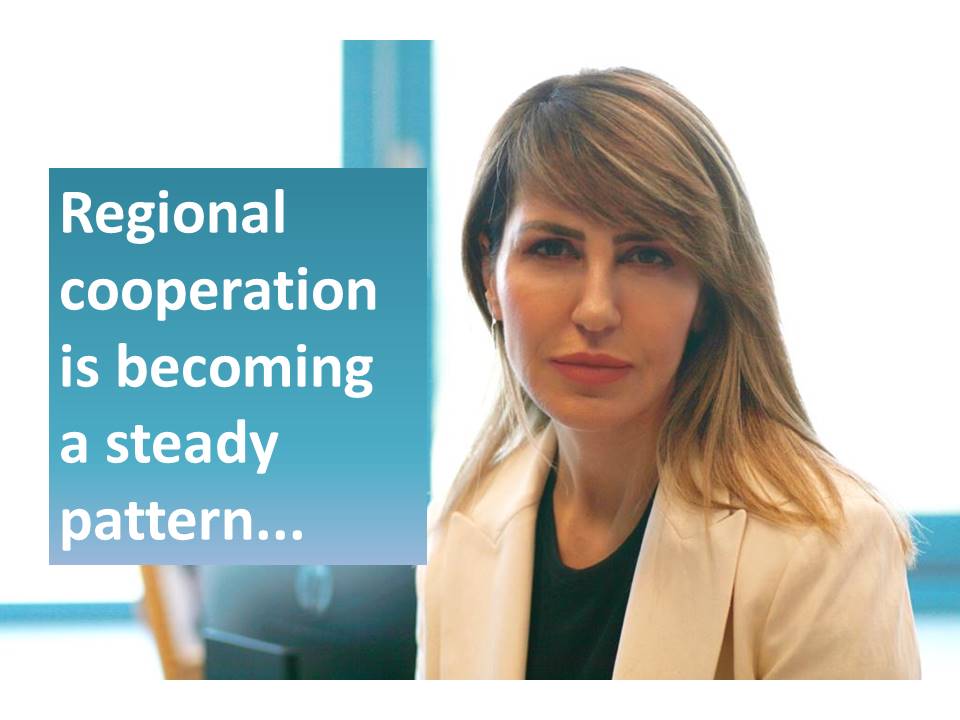
Regional cooperation is becoming a steady pattern to EU’s magnetic attraction
02 JULY 2019 | INTERVIEW
The article of the RCC's Secretary General, Majlinda Bregu tackles anticipations of the Berlin Process's Western Balkans Summit in Poznan, Poland, staring on 4 July 2019.
Summing the expectations up, Secretary General Bregu writes: On 1st of July, Roaming Reductions arrived. On 4th of July, the Western Balkans summit in Poznan will start. EU is a magnetic attraction, while regional cooperation is becoming a steady pattern. For the future, let’s look into the past because the unsavoury one is still a threat! But REA has a clear status with togetherness at its core. Let’s give REA and regional cooperation the force to chart a sustainable long term Western Balkan reconciliation! Through economy, lifting all existing barriers!
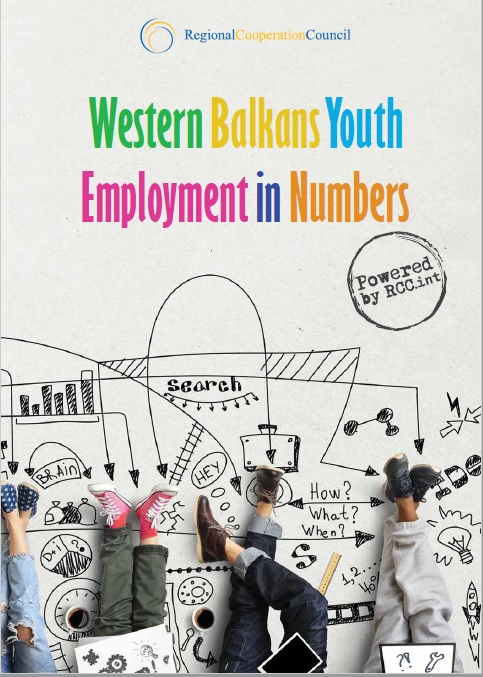
Western Balkans Youth Employment in Numbers
28 MAY 2019 | INFORMATION MATERIAL
The brochure "Western Balkans Youth Employment in Numbers" gives an insight into the main indicators on the youth employment in the Western Balkans, including the overall youth employment rate, statistical data, people's sentiment on this issue as well as recommendations on how to improve the youth employment rate in the region.
Download: EN
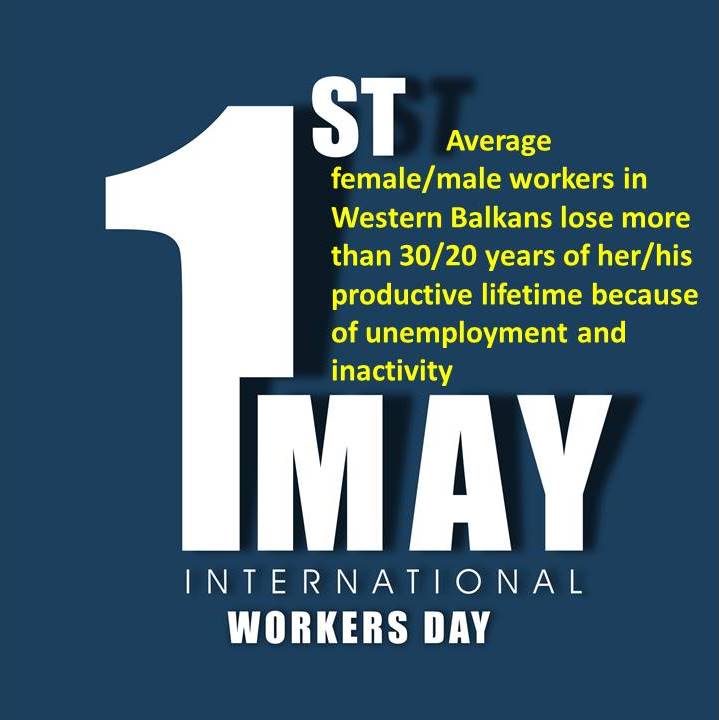
Article by Nand Shani, Team Leader of the Regional Cooperation Council (RCC)’s Employment and Social Affairs Platform (ESAP)
30 APRIL 2019 | INTERVIEW
In an article "One year of additional schooling raises income by 9 percent", Team Leader of the Regional Cooperation Council (RCC)’s Employment and Social Affairs Platform (ESAP) Nand Shani talks about the origins of 1 May - International Workers' or Labour Day, about the employment in the Western Balkans, challenges and opportunities the region is facing, achieved results and tasks within the employment activities RCC and the region are working on.
Chairs' conclusions of the Economy Ministers' Meeting of the London Western Balkans Summit 2018
18 JULY 2018 | MEETING DOCUMENT
The participants of the Economy Ministers Meeting of the Berlin Process met in Vienna on 4 July and issued the conclusions presented in the document. The meeting built on the achievements of previous Berlin Process Summits, the recent European Bank for Reconstruction and Development Western Balkans Investment Summit,
and the Skopje Digital Summit.
Download: EN
BALKAN BAROMETER 2018 - INFOGRAPHICS
06 JULY 2018 | INFORMATION MATERIAL
BALKAN BAROMETER 2018 booklet features the prevailing issues of the Balkan Barometer (BB) 2018 survey through infographics. The 2018 edition of BB is yet another instalment in the series of annual public opinion surveys commissioned by the Regional Cooperation Council. The entire BB survey is available at http://www.rcc.int/seeds
Download: EN
BALKAN BAROMETER 2018: BUSINESS OPINION SURVEY
06 JULY 2018 | SURVEY
2018 Balkan Barometer is the fourth instalment of the annual public opinion survey commissioned by the Regional Cooperation Council to gather and interpret data spanning a number of thematic areas and topics. The Barometer, as in previous years, examines both the region’s perceptions of today, and its expectations for tomorrow, giving voice to the SEE’s business community as well as its citizens at large.
Download: EN
BALKAN BAROMETER 2018: PUBLIC OPINION SURVEY
06 JULY 2018 | SURVEY
2018 Balkan Barometer is the fourth instalment of the annual public opinion survey commissioned by the Regional Cooperation Council to gather and interpret data spanning a number of thematic areas and topics. The Barometer, as in previous years, examines both the region’s perceptions of today, and its expectations for tomorrow, giving voice to the SEE’s business community as well as its citizens at large.
Download: EN
SOUTH EAST EUROPE 2020: 2018 ANNUAL REPORT ON IMPLEMENTATION
05 JULY 2018 | REPORT
A comprehensive monitoring effort was introduced to measure the progress of SEE 2020 Strategy's activities implemented and results achieved. This Annual Report on Implementation (ARI) is the main output of the SEE 2020 monitoring process. This 2018 report covers the period from June 2017 to June 2018 and is divided into two main parts: a summary overview of the progress achieved, issues arising and a reflection on some of the lessons learned and overall recommendations for adapting and strengthening the Strategy to meet the challenges of a dynamic political and economic environment in which it operates, and a detailed review per pillar.
Download: EN
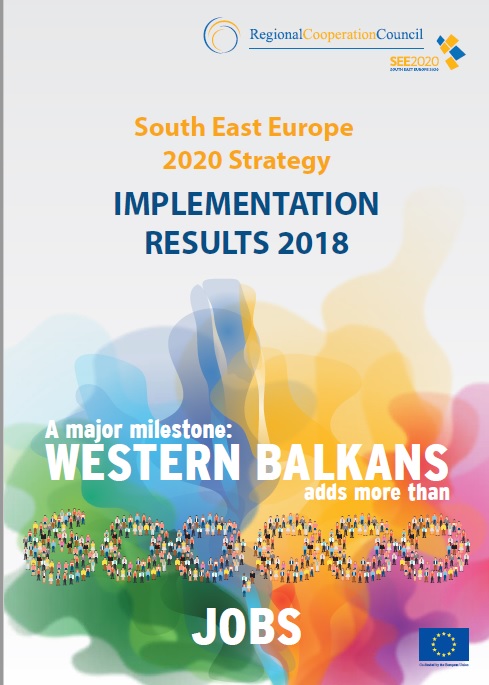
Brochure: South East Europe 2020 (SEE 2020) Strategy - 2018 IMPLEMENTATION RESULTS
05 JULY 2018 | INFORMATION MATERIAL
The Western Balkans has returned to the growth path, having added more than 600 THOUSAND JOBS to its economies since 2010 and half a million highly educated people to its workforce. The region expanded its trade by additional EUR 33 BILLION and decreased its trade deficit from -23.1 to -19.7 percent of GDP over the last 7 years through strong export performance, signaling increasing competitiveness of its products and services on the international markets.
Download: EN
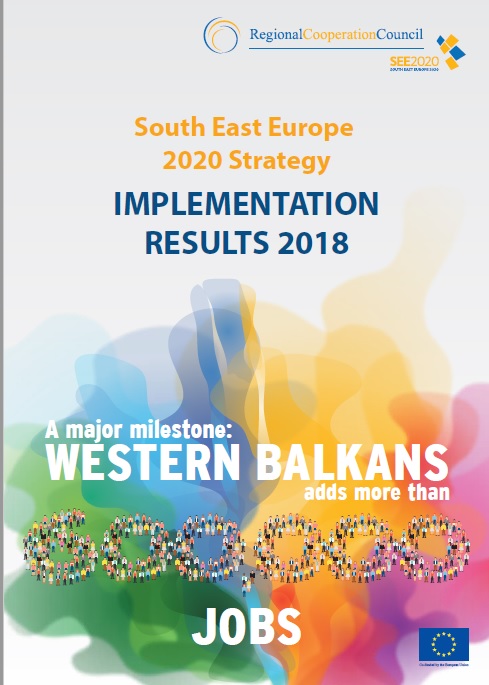
Brochure: South East Europe 2020 (SEE 2020) Strategy - 2018 IMPLEMENTATION RESULTS
05 JULY 2018 | INFORMATION MATERIAL
The Western Balkans has returned to the growth path, having added more than 600 THOUSAND JOBS to its economies since 2010 and half a million highly educated people to its workforce. The region expanded its trade by additional EUR 33 BILLION and decreased its trade deficit from -23.1 to -19.7 percent of GDP over the last 7 years through strong export performance, signaling increasing competitiveness of its products and services on the international markets.
Download: EN
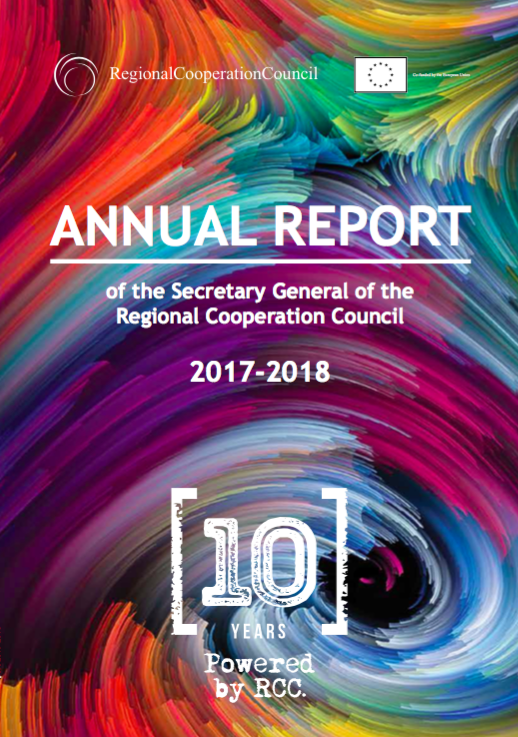
Annual Report of the Secretary General of the Regional Cooperation Council 2017-2018
23 APRIL 2018 | REPORT
This Annual Report of the Secretary General of the Regional Cooperation Council (RCC) covers the period 1 April 2017 – 15 March 2018. It outlines main RCC activities and achievements in the past year. It also lays out the overall background and crucial developments impacting and shaping the activities of the RCC and the region of South East Europe in the reporting period.
Download: EN

SEE 2020 Programming Document 2018-2020
13 MARCH 2018 | MEETING DOCUMENT
The RCC South East Europe (SEE) 2020 Strategy Programing Committee adopted the SEE 2020 Programming Document 2018-2020 at its 6th meeting on 12 March 2017 in Brussels. The document sets out the priority actions for the Strategy implementation in the coming period.
Download: EN
Conclusions from the Sixth Meeting of the SEE 2020 Programming Committee
12 MARCH 2018 | MEETING DOCUMENT
The sixth meeting of the SEE 2020 Programming Committee was held in Brussels on 12 March 2018 back to back with the Fourth Meeting on Donor Coordination in the Western Balkans. The aim of the meeting was to discuss and potentially endorse the SEE2020 Programming document for the period 2018 – 2020. The meeting gathered representatives of the South East Europe’s (SEE) economies participating in implementation SEE 2020 Strategy, including representatives from the Offices of the National IPA Coordinators (NIPAC Offices), SEE2020 National Coordinators and representatives from the institutions responsible for aid coordination.
Download: EN
Agenda of the Sixth Meeting of the SEE 2020 Programming Committee
12 MARCH 2018 | MEETING DOCUMENT
Agenda of the Sixth Meeting of the SEE 2020 Programming Committee held in Brussels on 12 March 2018
Download: EN
List of participants of the Sixth Meeting of the SEE 2020 Programming Committee
12 MARCH 2018 | MEETING DOCUMENT
List of participants of the Sixth Meeting of the SEE 2020 Programming Committee held in Brussels on 12 March 2018
Download: EN
Western Balkan Public Employment Services Benchlearning Initiative - Good Practices and Flagship Results
21 FEBRUARY 2018 | INFORMATION MATERIAL
The data presented in this brochure are result of the regional Public Employment Services (PES) benchlearning exercise, which included self-assessment and external assessment in crucial areas and aspects of PES performance fully aligned with the European Union (EU) PES benchlearning model, conducted in 2017 by the Regional Cooperation Council under the Employment and Social Affairs Platform – ESAP in each of the Western Balkans six economies.
Download: EN
Labour Markets in the Western Balkans: Performance, Causes and Policy Options
21 FEBRUARY 2018 | REPORT
The report is an analysis of trends in the Western Balkan Six labour markets since 2010 and provides recommendations for improving labour markets’ conditions. It focuses on conditions for job creation and factors leading to the employment problems of the region. This is a joint endeavor of researchers from the region and is the first comparative analysis of this kind covering recent years and made available to the regional and international audience in the English language.
Download: EN
BALKAN BAROMETER 2017: BUSINESS OPINION SURVEY
09 OCTOBER 2017 | SURVEY
The 2017 edition of BALKAN BAROMETER (BB) is yet another instalment in the series of annual public opinion surveys commissioned by the Regional Cooperation Council. It collects and analyses data across a host of thematic areas, examining aspirations and expectations of the region's populations and its business community on life and work, prevalent socio-economic and political trends as well as regional and European integration, among others. Balkan Barometer Business Opinion Survey conducted by GfK, among 16800 companies in the course of 2016 throughout our part of Europe, is an easy-to-access source of information. The RCC website www.rcc.int permits download of the publication as well as its datasets which are easily searchable.
Download: EN
BALKAN BAROMETER 2017: PUBLIC OPINION SURVEY
09 OCTOBER 2017 | SURVEY
The 2017 edition of BALKAN BAROMETER (BB) is yet another instalment in the series of annual public opinion surveys commissioned by the Regional Cooperation Council. It collects and analyses data across a host of thematic areas, examining aspirations and expectations of the region's populations and its business community on life and work, prevalent socio-economic and political trends as well as regional and European integration, among others. Balkan Barometer Public Opinion Survey conducted by GfK, among 8000 citizens in the course of 2016 throughout our part of Europe, is an easy-to-access source of information. The RCC website www.rcc.int permits download of the publication as well as its datasets which are easily searchable.
Download: EN

Multi-annual Action Plan for a Regional Economic Area in the Western Balkans Six
12 JULY 2017 | MEETING DOCUMENT
The leaders of Western Balkans Six (WB6) endorsed the Multi-annual Action Plan on a Regional Economic Area in the Western Balkans (MAP), prepared by the RCC, at the Berlin Process summit on 12 July 2017, in Trieste, Italy . The RCC has been tasked to monitor and inform on the progress achieved in MAP implementation.
Download: EN
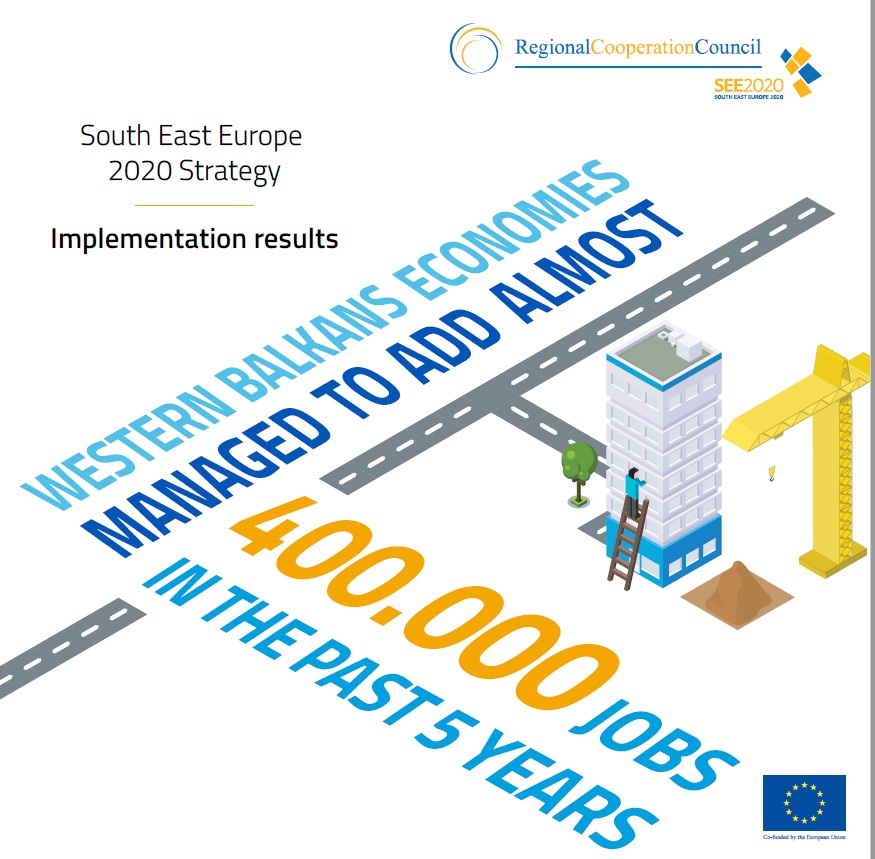
Infographics - SOUTH EAST EUROPE 2020: 2017 ANNUAL REPORT ON IMPLEMENTATION
28 JUNE 2017 | INFORMATION MATERIAL
This publication shows the most catching results in implementation of the SEE 2020 Strategy until December 2016 through Infographics. For full information where the SEE is when it comes to implementation of the SEE 2020 strategy, please check the South East Europe 2020: 2017 Annual Report on Implementation.
Download: EN
Employment and Social Affairs Platform (ESAP)
05 MAY 2017 | INFORMATION MATERIAL
Brochure of RCC’s Employment and Social Affairs Platform (ESAP) project features goals, results, and actions to be taken in the forthcoming period. The Regional Cooperation Council’s ESAP project aims to strengthen institutional capacities to effectively develop inclusive and dynamic labour markets and implement social policy reforms aligned with the EU enlargement requirements in the region.
Download: EN
Skills and Mobility
06 APRIL 2017 | INFORMATION MATERIAL
Brochure on RCC’s flagship ‘Skills and Mobility’, featuring goals, results, and actions of the organization in this area to be taken in the forthcoming period. The Regional Cooperation Council is working towards globally competitive base of knowledge and skills in South East Europe; unhindered movement of people, students, researchers and workforce, allowing for increased employment opportunities and creation of new jobs.
Download: EN

SEE 2020 Programming Document 2017-2019
17 MARCH 2017 | MEETING DOCUMENT
The RCC South East Europe (SEE) 2020 Strategy Programing Committee adopted the SEE 2020 Programming Document 2017-2019 at its 5th meeting on 15 March 2017 in Sarajevo. The document sets out the priority actions for the Strategy implementation in the coming period.
Download: EN
Balkan Barometer 2016, Infographics, pocket edition
10 NOVEMBER 2016 | SURVEY
Balkan Barometer 2016 edition is a comprehensive survey commissioned by the Regional Cooperation Council (RCC) on attitudes, experiences and perceptions of the general public and business community in South East Europe on various economic, social, political and cultural issues. It is an integral part of the annual monitoring process of the SEE2020 Strategy. Balkan Barometer pocket edition reveals the main thoughts of people and businesses on burning issues facing our economies, through infographics. This survey, conducted by GfK, among 8000 citizens and 1800 companies through our part of Europe, is an easy-to-access source of information. The RCC website www.rcc.int permits download of both components of the Balkan Barometer - Public Opinion Survey and Business Opinion Survey - as well as their datasets which are easily searchable. Check it out at: http://www.rcc.int/seeds/results/2/balkan-opinion-barometer and http://www.rcc.int/seeds/results/3/balkan-business-barometer
Download: EN
Balkan Barometer 2016: Public Opinion Survey
21 JUNE 2016 | SURVEY
The Balkan Barometer, published for the first time in 2015, surveys 7,000 citizens and 1,400 businesses in seven SEE economies, on a wide range of issues dealing with the political, socio-economic, business and investment climate, infrastructure, rule of law and other developments in the region. This year’s survey also includes select information on Moldova and Slovenia, giving a wider overview of the South East European region. The Balkan Barometer 2016 is published in two volumes: The Public Opinion Survey, detailing the citizens’ attitudes, and the Business Opinion Survey, summarizing the business sentiments. The research and publications have been prepared and developed in cooperation between the RCC and the GfK, one of the world’s largest market research institutes.
Download: EN
Balkan Barometer 2016: Business Opinion Survey
21 JUNE 2016 | SURVEY
The Balkan Barometer, published for the first time in 2015, surveys 7,000 citizens and 1,400 businesses in seven SEE economies, on a wide range of issues dealing with the political, socio-economic, business and investment climate, infrastructure, rule of law and other developments in the region. This year’s survey also includes select information on Moldova and Slovenia, giving a wider overview of the South East European region. The Balkan Barometer 2016 is published in two volumes: The Public Opinion Survey, detailing the citizens’ attitudes, and the Business Opinion Survey, summarizing the business sentiments. The research and publications have been prepared and developed in cooperation between the RCC and the GfK, one of the world’s largest market research institutes.
Download: EN
Balkan Business Barometer 2015
06 MAY 2015 | SURVEY
The report presents the results of the RCC-commissioned survey of business sentiment in SEE on crucial economic and development issues, intended to engage more closely the business community in context of the RCC’s SEE 2020 Strategy. The survey was carried out in December 2014 by GfK, and was conducted face to face with 1400 companies of different size and different business areas, which are not majority-owned by the state or government, in all seven economies covered by the Strategy.
Download: EN
Balkan Opinion Barometer 2015
06 MAY 2015 | SURVEY
The report presents the results of the RCC-commissioned survey of public opinion of SEE citizens on crucial economic and development issues, intended to engage more closely the general public in context of the RCC’s SEE 2020 Strategy. The survey was carried out in December 2014 by GfK, and was conducted face to face with 7000 respondents, in all seven economies covered by the Strategy.
Download: EN
South East Europe 2020 strategy
21 NOVEMBER 2013 | REPORT
The goal of the South East Europe (SEE) 2020 strategy of the Regional Cooperation Council (RCC), is to improve living conditions in the region and bring competitiveness and development back in focus, closely following the vision of the EU strategy Europe 2020. It stresses out the shared vision of the SEE economies to open up to 1 million new jobs by 2020, by enabling employment growth from 39% to 44%, increase of total regional trade turnover by more than double from 94 to 210 billion euro, the rise of the region’s GDP per capita from current 36% to 44% of the EU average, and the addition of 300,000 highly qualified people to the workforce.
Download: EN